[00:00:09.14] - Gordon
Hello.
[00:00:09.26] - Taylor
Hello.
[00:00:10.15] - Gordon
My name is Gordon from Drayson Design.
[00:00:12.14] - Taylor
And I'm Taylor from The Creative Tinker.
[00:00:14.12] - Gordon
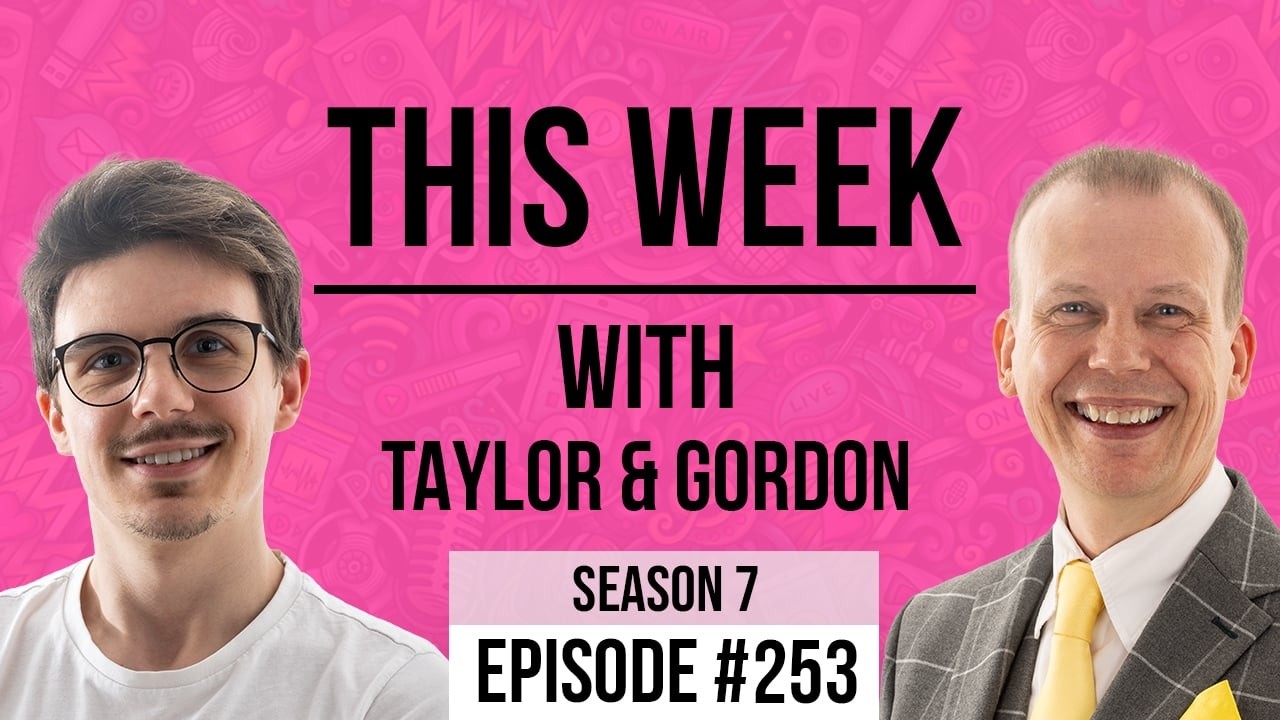
And welcome to "This Week with Taylor and Gordon," a weekly podcast and vidcast where we talk about things that have affected our businesses over the last 7 days, and thank you so much for joining us. It's been a hot week.
[00:00:27.27] - Taylor
It has.
[00:00:28.18] - Gordon
Yeah. I think I've said this before, but I struggle in the heat. It's also been a very busy week for me because we're getting to the end of the school year. And so I've had lots of nurseries and schools and pretty much every day, actually not pretty much, every day this week, I've had at least one show. And on some of the days I've had two, which means that I haven't had a chance to get much done in the office. But, you know, we have these times when, as they say, make hay while the sun shines. And, you know, when there's shows available during the week, which is not as common as it would— I would like it to be, you go and do them, you know, because next month is a lot quieter, which is good because I want to go on holiday. But anyway, that's for for another time. Football? Yeah, that's been on this week as well. Anything affected your week before we get into the topics?
[00:01:31.27] - Taylor
I don't think so.
[00:01:32.19] - Gordon
No? Okay, let's get straight into those then. So would you like to go first or shall I?
[00:01:37.10] - Taylor
This week I want to talk about Zen Browser.
[00:01:40.23] - Gordon
Ooh.
[00:01:41.18] - Taylor
So Zen Browser is a browser that is based on the Mozilla Firefox browser. So it's kind of like a fork on top of the, yeah, the original browser. And the concept is you have a left sidebar. So instead of having your tabs along the top, you have them down the left side and you can then show and hide them, kind of collapse the panel. And what it does, it allows more real estate essentially, but it changes the way that you browse the internet as well. There's no kind of new tab per se. You just have a little floating window that pops up and you type what you're looking for, whether it's the search, you know, a search term in Google, or if it's actually a website address that you want to go to, and then it just takes you to that page. You still have tabs in the sidebar, but there's no kind of start screen. You know, sometimes when you create a new tab, it will go to a start screen or just go straight to Google, wherever, but there isn't that. You kind of just have a little pop-up. And there's a lot of other things that are reimagined. You have kind of like pinned tabs. So you instead of have like, you know, things that are most common that you use, you can pin to the top in these little like cards. Essentially they're kind of like a 3x2 grid, and you can then jump to them at any time. And then they also have workspaces, so you can swipe between different workspaces and you can route websites to them. So if you have a workspace for your company or for a business that you do work for, you can have all of the kind of sites that you go to for the project management all go to that one workspace. So I have one of my clients, we have an internal tracking tool for tasks and things like that, and I have it— if I ever click on a link from anywhere, it will automatically open it in that space. So it keeps everything tidy. Now, some of these things aren't new, they've been around for a long time. There was a browser called Arc, which was created by the browser company but no longer is maintained because they've decided to build a new browser.
[00:03:50.20] - Taylor
But Arc was kind of the first browser to kind of have this left sidebar tabs idea. And I really like the idea and it's been around for a while. And the Firefox browser and other Chromium browsers have started to adopt it in their own way. But I didn't like, I don't like Chrome, I don't like anything to do with Chromium just because it's not a, it's not very performant, and they are quite resource heavy. It also comes with a lot of tracking because Google is the one that kind of builds it. And so I've always been a Firefox person. I really like the developer tools. And so when I came across Zen, I kind of— it was kind of the best of both worlds. It was built on Firefox, so it has all of the privacy stuff built in, which kind of blocks tracking by default, and all the niceties that Firefox has, but with this kind of forked version that builds on top of the UI and adds kind of the Arc-style UI, which I thought was really nice. So I started, I gave it a go and I'm really enjoying it.
[00:04:57.24] - Gordon
Yeah, it's interesting because there's three, well, I guess at the moment there's three main browsers now, isn't there? There's Safari, there's Firefox, and there's Chrome. I'm not sure that Edge is still a thing, is it?
[00:05:09.29] - Taylor
Well, so you kind of have three types of browsers. You've got WebKit, which is Safari.
[00:05:16.24] - Gordon
Safari, yeah.
[00:05:17.13] - Taylor
Uh, you have Chromium, which is Chrome, Edge, Brave, all of those browsers, Arc. They're all built on Chromium.
[00:05:25.23] - Gordon
And then you have, um, Mozilla, you know, the Firefox, um, Foundation and the kind of Firefox, um, yeah, you know, it's interesting to see which direction they all go and, you know, how quickly, because the browsers make a difference in how quickly you can browse and do things. As you said, resource hungry for Chromium and tracking as well. Safari and Firefox are both better for not tracking, which is why I always recommend if you've got a Mac, go with Safari, or if you're on a PC, go with Firefox, because you're not going to be tracked as much with either of those.
[00:06:06.17] - Taylor
Yeah, it's interesting. I think Chromium is obviously the biggest, has the biggest user base, and so a lot more things are supported. So there's a lot more Chrome extensions, and while you can port a lot of Chrome extensions to Firefox, for example, there just isn't as much support. But, you know, it's getting there. And so that's obviously one of the downsides is that sometimes things aren't as supported for, you know, Safari or for Firefox. But, you know, you can do more kind of with Chrome, I guess. And that's why Chrome became very popular, was because it's very customizable, you know, and a lot of them are getting there. But again, they all have their own ways of doing stuff, it's kind of whatever works for you. But I've always liked Firefox, I've always liked how the dev tools look and work, and all those kind of features. But it does mean that you then have 3 different kind of browsers to make sure stuff works on, because you have WebKit prefixes, which is stuff that's only for Safari, you have Firefox ones, and there's also, you know, Chrome, and they all integrate different features into their browsers.
[00:07:17.07] - Taylor
So sometimes you'll find that one CSS thing or one kind of JavaScript thing works on two of the browsers but not the other. And so it's a constant battle between trying to figure out if you can use a certain feature or a certain, —yeah, a certain feature based on how widely supported it is.
[00:07:37.29] - Gordon
Yeah, and they adopt things at different paces as well. So WebP is now a very popular image format, but that took a while to come to all of the browsers. And, you know, you had it in one browser, not the others. Therefore, you had to consider, was it worth using it now or waiting until it was adopted by everyone? And if you didn't use it and everyone else didn't use it, it may never have got adopted. So it's a bit of a—, you know, catch-22 in that respect.
[00:08:06.08] - Taylor
Yeah, it's tricky. I think when you have a website that is dev-oriented, you know, especially when, what's the old one that's no longer supported? I can't think what it's called. The browser that died that was kind of Microsoft's original browser.
[00:08:28.08] - Gordon
Internet Explorer.
[00:08:29.08] - Taylor
That's the one. When that was still supported, there was a lot of stuff that people had to do for backwards compatibility. So when that died, then a lot of stuff opened up and was able to be added in a lot quicker. But there's still lots of things that aren't supported or have different support levels. But also the type of people that are using it. If you're building government stuff, there's still a lot of services and a lot of stuff that's built and only is used on Internet Explorer. So you have to make sure that it works in Internet Explorer, whereas if you've got a more developer-oriented— so things like The Admin Bar, for example— Kyle kind of knows most people are going to be using a modern browser, so he can use these more experimental features because, you know, his audience kind of are going to be using them.
[00:09:19.05] - Gordon
And I think that's just it, isn't it? What are your audience likely to be using? It might be that they're using a mobile, and therefore, you know, mobile first is a good thing for you for that. But again, you've got different browsers on different mobiles, so again, that's another thing to check with, isn't it?
[00:09:35.09] - Taylor
Yeah.
[00:09:36.17] - Gordon
Excellent. Very good. Today I have, well, this week I had a couple of personal things that happened. We had our pantomime auditions. I realise it's quite early, but we always have our pantomime auditions in July. I think the reason is so that people can block the rehearsal period and then Christmas, because, you know, Christmas gets busy. So if you know you're going to be doing pantomime as early as July, you can can block that time out. So, we had panto auditions, and I got a call asking if I would like to take the part of the Dame, which is lovely. So, in January, I should be playing the part of Dame. But also this week, another company, ATG in Warlingham, asked me if I would take a role in their next play, which is called Murder in the Mine.
[00:10:33.07] - Gordon
It's all about a slate mine, and I was asked and read the script, and I am now taking the part of a character called Brian.
[00:10:42.20] - Taylor
Okay.
[00:10:43.24] - Gordon
Who is a slate enthusiast. So, there we go. That tells you pretty much everything you need to know. But what's really nice about this show is it's sort of one act, then you have the interval, and then the audience get to interrogate the cast members to see if they can figure out who did the murder. And then at the end, you have a little dénouement. So it sounds like it could be a lot of fun. A bit of impro going on there. I never say impro. A little bit of improv going on there. So that's going to be quite exciting. And that's happening before pantomime. So I sort of finish that and then have Sunday off and go straight into pantomime rehearsals on the Monday. So that's my second half of my year taken care of with two different shows. But the thing I wanted to talk about today was something that we touched on last week, which is this Booked Solid OS thing. Lots of things have been happening with this.
[00:11:39.17] - Gordon
So it's now been bought out by another company, which is very interesting because they've only just released the app. And I purchased it only 2 weeks ago, and I looked into the person who was selling it to see if, you know, doing my due diligence. And now after I've purchased it, it's been sold to someone else. And, you know, I know this other person. I've had, you know, a product that I purchased from him that he sort of shut down. And so it's made me a little bit nervous about the product. And, you know, the person who originally had it has, you know, not really done the timings very well on this because, you know, he encouraged everyone to purchase it before the price went up. And then about, you know, 3 days after everyone purchased it and the price went up, he then sold it to someone else, which is, you know, I feel a little bit underhand and he's trying to spin it in a good way that you'll get all these extra, you know, developers on board and etc, etc. But I'm just not sold on it.
[00:12:47.18] - Gordon
You know, if he's, it sounds like he's sort of made a tonne of money and now he's jumping ship, you know, that's how it could be interpreted. I don't think that is how it's happening. I just don't think he thought it through properly. But anyway, one of the things that this system, which I still don't have fully running properly, but one of the things it does is it allows you to, collect and create draught replies to emails. And it can also look at your calendar. And so one of the things I considered doing, which I don't do currently. So I've got my Online Booking Assistant, which monitors my children's birthday parties and sends out relevant emails, and emails after the event to thank them and ask for feedback and so on. If I'm doing a nursery or a school or something like that, club maybe, I don't have follow-ups for those because I don't put them onto a follow-up sequence, mainly because they don't require as many sort of emails going out. I mean, I could do, I could set up a sequence that I could use. And that is something maybe I should look into.
[00:14:02.02] - Gordon
But what I can do is look at all of the people who book me on an annual basis. So because we're coming to the end of the school year now, I'm doing lots of nurseries and schools, which I do year in, year out. In fact, some of them I do twice a year. I go sort of this time, and I go in December and do a Christmas show for them. And so it's nice to sort of keep them on board and to communicate with them and send out emails even when you don't need to, just to say, you know, "lovely to have come and entertained for you, really looking forward to seeing you at the next one. Do you have the date yet?" Because then you're sort of asking them to rebook you at that time if you haven't already been rebooked, because some of them I go to and when I leave, they give me the date for the following year when I'm leaving. So I can put it in the diary and book it straight in. But others don't do that. They leave it for a little time. But, you know, these are customers that are coming back to you again and again.
[00:15:05.23] - Gordon
And you only need to, you know, upset them or not do as good a job as you have done or find that you're not available when they need you and they'll book someone else. And then they'll just potentially go with that other person and you lose this annual job. So it's a good idea in my opinion, to keep a communication channel open with them, thank them for bookings, send them an email if you haven't heard from them, you know, at the sort of time that they would normally book. So again, that's dependent on when they do book and this Booked Solid OS, I can tell it when these people book. And if I haven't got the booking in the diary, it can create an email for me that I can send to remind them that they haven't booked yet and do they have the date, but in a nice way. Sort of make it sound like the email is being sent to them as a sort of an assistance and a help rather than a, "you haven't booked me yet, give me a day." Because you don't want to come across as begging for the work, but you do want to come across as being concerned you haven't heard from them.
[00:16:18.23] - Gordon
So, that's something that I've never done, and I think I should, because over the years, I have lost annual shows that I've been doing. And it could be that, you know, the person who books me has moved on to another company or another school, and maybe the replacement doesn't have my contact details. That's a possibility. So they just don't know how to contact me. So my emails, by sending them to the school or the nursery, if it goes to the wrong place, I'll get an email back saying, this person no longer works here, try contacting this person. And then at least I know that I've now got a new contact that I can replace and send that email to, and then they'll have my details. And so therefore I won't not get booked because they don't have my contact details, which has got to be the worst way of losing work, I think, people not being able to find you. So that's something that I'm going to be putting into place for the future. I've got a spreadsheet that I already put my annual bookings into, and I sort of say whether I'm booked or not, or whether it didn't happen, because that also is the case sometimes.
[00:17:28.10] - Gordon
So it's going to be something that I'm going to keep a close eye on and let Claude, because that's the system that's underlying the AI that's underlying this Booked Solid system, is working on. So let them know, let Claude know when these bookings come in, to check the bookings, see if they have come in, and if they haven't, just send a polite reminder, you know. And I think we can learn from that with other things as well. So, you know, if you've got customers that come to you regularly, don't take them for granted. Make sure you send emails to thank them for their business and make sure you send, you know, an email every now and then, just very, very irregularly, just to say, you know, "hope you're well. I'm just checking in, seeing if everything's okay." Because I think, you know, it's nurturing that relationship that is the reason people come to you, or stick with you. Sometimes it's just because, you know, it's more hassle to move elsewhere or get another supplier. But most of the time it's because they like what you do and they like you. So it's always a good idea just to send these little emails and, you know, just check in on them, check, make sure everything's good, see if there's anything you can help them with. Anything you want to add to that?
[00:18:49.03] - Taylor
Don't think so. I mean, something that I know one of my friends does is they have a time since last contacted, and they have an automation that basically keeps track of when did this person last contact— when did I last contact this person, whether it was because the person reached out to them or because they reached out to the other person. And, you know, it sends them an email saying, "hey, you haven't followed up with this person for 90 days, drop them a message." You know, "is there something you can tell them that a new feature for," you know, for in our case, you know, is there a new feature for a plug-in that they're using that has been released and just saying, "hey, this is, you know, now available to you, is it something you're interested in?" Or "hey, I've been keeping your website secure and updated." Or just asking if there's anything that they can help with. And sometimes you can actually get work from it because they go, "oh yeah, I've been meaning to message you because I want to add some new photos," or whatever. And so, yeah, keeping in touch with them, just, yeah, like you said, nurtures them and keeps them front of their mind.
[00:19:55.08] - Gordon
Yeah. Good. That's everything for me.
[00:19:57.13] - Taylor
And me as well.
[00:19:58.07] - Gordon
Thank you so much for joining us. As always, if you're on YouTube, please like, share, and subscribe.
[00:20:04.17] - Taylor
You can also go to our website, thisweekwith.co.uk, to find all of our past episodes.
[00:20:09.06] - Gordon
And if you would prefer to listen to us rather than watch us, we're on all the major podcast platforms and also your smart speaker. Just search for "This Week with Taylor and Gordon." We'll be back with you at 1pm next Friday. Until then, my name is Gordon and I'm from Drayson Design.
[00:20:29.03] - Taylor
And I'm Taylor from The Creative Tinker.
[00:20:31.16] - Gordon
Goodbye.
[00:20:31.28] - Taylor
Bye.