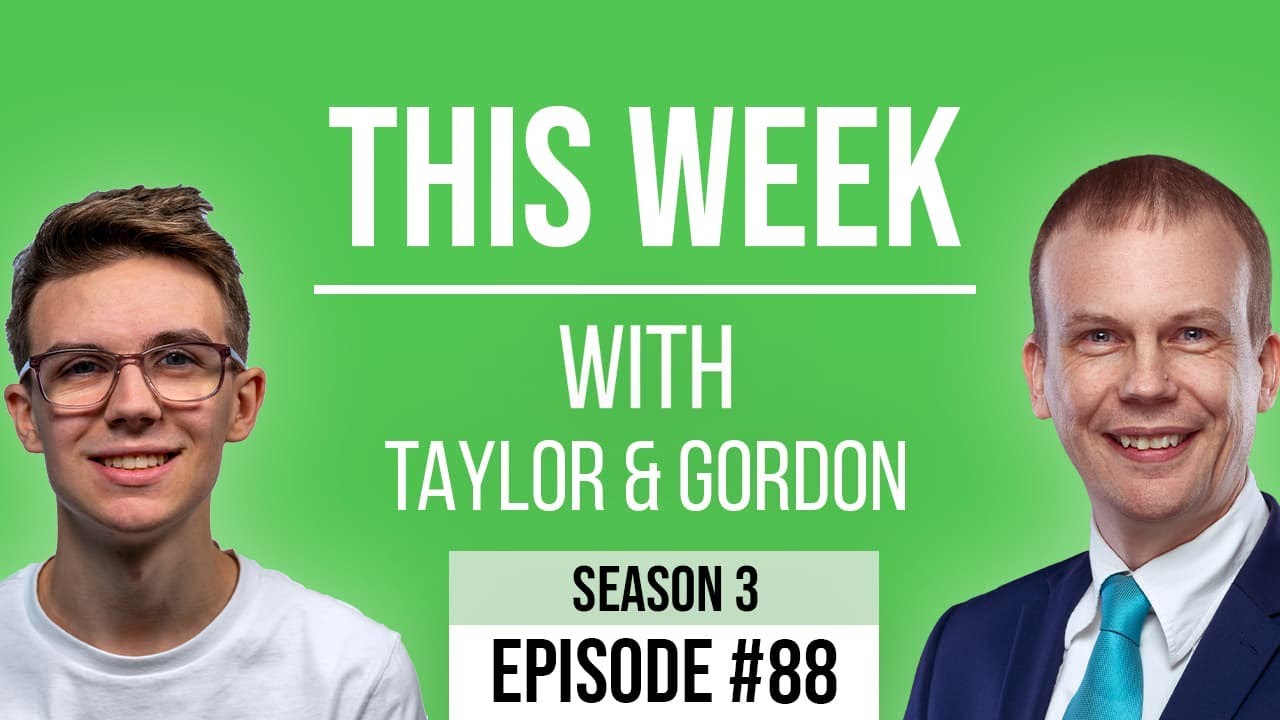
[00:00:10.210] - Gordon
Hello.
[00:00:10.750] - Taylor
Hello.
[00:00:11.260] - Gordon
My name's Gordon from Drayson Design.
[00:00:13.090] - Taylor
And I'm Taylor from The Creative Tinker.
[00:00:15.380] - Gordon
And welcome to "This Week With Taylor and Gordon, a weekly podcast and vidcast where we talk about things that we've had affecting our businesses over the last seven days. Started thinking about something else, as I was saying, that you could tell, could you?
[00:00:29.260] - Taylor
Yeah.
[00:00:29.970] - Gordon
So it's a really busy day. We've had a very busy week, as we always do. But you can see that I'm in my 'Gordon's Magic' outfit. And that's because as soon as we finish this live, I've pretty much got to dash into the car and rush off to do a show. So that's why I'm dressed like this today. So let's just see, what have we been doing since last week? We went to Secret Cinema, didn't we?
[00:00:56.500] - Taylor
We did.
[00:00:57.030] - Gordon
Which was great. We all dressed up in our finery and we went to a ball, didn't we?
[00:01:04.370] - Taylor
We did indeed.
[00:01:04.370] - Gordon
It was 'Bridgerton.' And if you've not been to a Secret Cinema, I highly recommend that you do. We would like to thank Marc Summers for the tickets for that because he was due to go and because he's in America, he was unable to come over. So he allowed me to invite some of my friends and we had a fantastic time. We really did didn't we?
[00:01:29.400] - Taylor
Yeah it was really good. I enjoyed it.
[00:01:30.600] - Gordon
Yeah, it was really good. Plus, last week I told you that I'd been working on my editing of the DVD for the dance school show, and I'm very pleased to say it's now finished. This is the DVD. This is the list of everything. And there's the disc inside, all lovely printed. And it goes in a nice sealed plastic bag, basically just to keep it nice. And I'm sitting here, there's a box just down there of 50 of them, all ready to be delivered tomorrow. No, wait. Friday. Today! They're going today. We're going to have our premiere this evening where we're going to go and sit and watch it with some of the teachers and some of the students. So that's my week. Anything interesting happened in your week, Taylor?
[00:02:25.870] - Taylor
No, my week was mainly just consisted of driving. So we went up to Cambridge. So I drove up to Cambridge.
[00:02:32.550] - Gordon
We did. I forgot all about that. We went for my cousin's 50th birthday and we went for a celebration and they had a ceilidh band.
[00:02:40.860] - Taylor
They did.
[00:02:41.600] - Gordon
And so we were doing lots of dancing, which was great.
[00:02:44.340] - Taylor
Yeah.
[00:02:44.710] - Gordon
Another really nice event.
[00:02:46.610] - Taylor
Yeah. So I was doing lots of driving. I drove up to Cambridge and back, and then I also picked up my friend from Colchester to bring him back to Croydon because he goes to University up there. So, yeah, a lot of driving this week mainly.
[00:03:03.050] - Gordon
And you can't be doing work when you're driving, really, can you?
[00:03:06.620] - Taylor
Not really, unless you're answering phone calls.
[00:03:09.140] - Gordon
Well, that's right. And in fact, one of my jobs, on my way to my job today, and back is to listen to my lines. I'm in a play, a Noel Cowerd play called "Present Laughter," and I'm struggling learning my lines. It's not a big role, but it's big enough to have to learn some very flowery language. And, yeah, it's not how we normally speak and therefore it's causing me a few problems to learn it. So my way of doing that is to record it and to play it back over and over and over. The same way we learn the words to a song and the tune to a song by sort of Osmosis. We absorb it as we listen to it, and that's what I'm going to be doing with these words, I hope. Wish me luck.
[00:03:56.220] - Taylor
Cool.
[00:03:57.040] - Gordon
So would you like to start today?
[00:03:59.600] - Taylor
Yeah, I'll start today.
[00:04:00.820] - Gordon
Okay.
[00:04:01.500] - Taylor
So a while ago I had an idea and also had a couple of other people that were interested, in creating a distance calculator. So this is where you put in an address and it tells you how far you are in terms of time to drive there and also kind of like miles or kilometres. And I had a bit of free time, so I was like, "let me try and build this." I originally started off with the Google API, which they have something called the 'Distance Matrix,' which is essentially what this is. And Google just don't make their APIs easy to use, and they make you authenticate with everything. So I decided to scrap that and went looking for another one. And there was actually a service called, I think, "Distance API" or something like that that did exactly what I wanted. Pretty much the exact same as the Google one, just about 100 times easier and not as complicated.
[00:04:58.330] - Gordon
Same results.
[00:04:59.370] - Taylor
Yeah, exactly. Exact same results, which was quite nice. And they had a couple of things in there that you could add and extend it; so you could choose the units you wanted, so imperial or metric. You could pass in multiple addresses to the to and from, and it would do a matrix on it. So then it would do one to one and then one to two, one to three, and then do two to one, two to two, two to three. So it does all of the calculations for all of the addresses, and you can then use the addresses that you want, essentially. And there's lots of other things in there. You can decide by car, or say you want to go by public transport, by walking, all of these different things.
[00:05:45.050] - Gordon
Does it take into account traffic?
[00:05:46.830] - Taylor
Yes. So you can say the time you want to leave and it will tell you...
[00:05:50.080] - Gordon
And the day? Because it has historical... Google Maps, for example, has historical data, so it knows that a specific time of the year is going to take longer.
[00:06:00.490] - Taylor
So it takes like the average really.
[00:06:02.260] - Gordon
Okay.
[00:06:02.980] - Taylor
But, yeah, it was really interesting. And yeah, so I built kind of like a demo, a working version where you can put in any address. So it can be either postcode or kind of like when you put Google Maps and you search for a company and it kind of gives you the result.
[00:06:18.780] - Gordon
So it auto fills?
[00:06:19.890] - Taylor
It doesn't auto fill, but it will kind of just try and figure out the closest from what you've put in. So if you're 'Buckingham Palace,' it will return you Buckingham Palace. But if you put 'Starbucks,' you could get any Starbucks because it doesn't have a specific one. So I guess it should be the top result when you're using. Because what they do is they take your result and they geocode it to a latitude and longitude.
[00:06:43.940] - Gordon
Yeah.
[00:06:44.190] - Taylor
So you can also pass in a latitude and longitude if you want to. But if you don't, it will automatically do that for you. So you'll get slightly different results. If you wanted the front of your office building, you could give the actual latitude and longitude of that. Whereas if you just put your building, it may put you bang in the middle of your office.
[00:07:02.220] - Gordon
Okay.
[00:07:02.490] - Taylor
So you've got kind of different variations of where it will be basically. But yeah, I created a working version and yeah, I got distances to Buckingham Palace, to I think Manchester Arena. But this can be used in a lot of situations where probably in your industry quite a bit where people are looking for someone to entertain and they put in their address and you kind of go, "ooh, that's a bit far for me to go." And either that means that the price that I'm going to quote you is going to be slightly higher because I've got to take into account the time...
[00:07:39.380] - Gordon
Travel time.
[00:07:40.520] - Taylor
Or you just say "look, sorry."
[00:07:42.360] - Gordon
And fuel costs these days.
[00:07:43.570] - Taylor
Yeah, fuel cost. Or you just say "look, sorry, I don't work in this area. However, I can recommend you X person who does work in this area." If you had a database of people that, of regions that you can then say if the address is within X region, then show this person, or you say "that's great, I work in this area and please continue." So you can kind of stop them from being able to submit a form or give them an alternative route if they are not in the area. Could be also useful for people that do deliveries and things like that. Because if you are creating an app for a delivery service, you can calculate the distance between each house, I guess.
[00:08:31.750] - Gordon
Delivery.
[00:08:32.730] - Taylor
And you can also use that to create a kind of like a route, because you can then calculate the smallest distance between each.
[00:08:43.140] - Gordon
Optimize it.
[00:08:43.900] - Taylor
Yeah, and calculate the smallest distance between each house and work out which route is going to be the most efficient and you're not double backing on yourself multiple times. So there's lots of use cases for it. And it was mainly just me trying to work and figure out how to use this API, but also just seeing what I could come up with and what it could be used for.
[00:09:04.830] - Gordon
What's your interface at the moment? Is it a form?
[00:09:06.880] - Taylor
Yes, it has an input field you put your address in, whether that be postcode, latitude and longitude, or just kind of like 'Buckingham Palace' address. You hit 'calculate.' It has a loader that says "calculating," which is when it's making the API request, and then it returns you and it says either "yes, I can work for you" or "you're in the area" or "sorry, no, it's not." And then underneath it gives you the location details or the travel details. So it would say "travel time is..." And then it gives you actually both the value of it in seconds, so if you're using it in app, you can convert it to whatever. And it also gives you a text, so it will say 1 hour, 22 minutes for example, or whatever that is in seconds. And then the same with the distance, it will say it is 4.5 miles away, or it will give you the fixed value that you can then calculate.
[00:10:06.710] - Gordon
And is there a way to get a map representation of this?
[00:10:10.190] - Taylor
You would have to use some other service to put your two addresses in essentially to achieve that. So that wouldn't be in the API. But there are lots of other things. Like I said, you can do walking, you can say you want to go by public transport, the time of day you want to go. So there's lots of different parameters you can add to the API to make it more customized and personalized.
[00:10:35.990] - Gordon
That's very interesting. Well done you. So you don't have any use for it at the moment, but you've got the knowledge to do...
[00:10:42.150] - Taylor
Well, I have a friend who wanted something similar and just never found the time to try and sit down and work it out. So I thought I would kind of help them and give them a starting point, which they can obviously use.
[00:10:54.080] - Gordon
Very kind.
[00:10:54.910] - Taylor
The pricing was fairly reasonable. I think that the lowest one you can buy, like a fixed... You can either buy pay as you go monthly or you can buy fixed credits. It was something like $20 or $19 for 10,000 requests. So 10,000 requests should last you a while if you're like a local business. If you are getting more than that, either that's because of a spam, or because you're very very busy and that's obviously great. So, yeah, I thought it was reasonable for it.
[00:11:23.940] - Gordon
Maybe that's something to suggest to your 'one simple API' guy. Maybe he could come up with something that would allow you to...
[00:11:33.760] - Taylor
Yeah, potentially.
[00:11:34.590] - Gordon
To do it with that. That would be great.
[00:11:36.010] - Taylor
I think he's currently working on a Google Sheets API. So you can turn any Google spreadsheet into an API, which is quite cool.
[00:11:43.690] - Gordon
Very nice, very good. Is that everything for you?
[00:11:46.360] - Taylor
Yeah, that's everything from me this week.
[00:11:47.720] - Gordon
That's very exciting. Well done. So my topic today is about priorities. So priorities is a very interesting concept. Very interesting word. We use it all the time. We prioritize jobs that we have to do. We prioritize tasks, if we have a To Do list. There's lots of things we prioritize. But in particular, I want to talk about prioritizing when making a purchase. So whether that be hardware or software in our case, and different people prioritize things in different ways. So we were looking at your purchase of your laptop a couple of weeks ago, and the biggest priority as far as I could see for you was the size of the screen.
[00:12:40.670] - Taylor
Yep.
[00:12:40.670] - Gordon
So the idea is that you had a laptop which worked perfectly fine, but you needed more space on the screen to get more done. So that was your top priority. Okay. Now, there are also other things that you'd already decided. You were going to get a Mac, you were going to get a laptop, that was already decided.
[00:12:58.670] - Taylor
Yep.
[00:12:58.670] - Gordon
But the priority for you was the size of the screen, and that's why you ended up getting the 16 inch MacBook. But what happens if you've got several priorities? You have a want for a particular piece of software, for example. You need it to do X, Y and Z. Went all American then. You need it to do all sorts of things. But what you need to do is you need to sit down and you need to prioritize all of these priorities. Now, you obviously know that these are all very important, but you have to decide what is the most important for you at that time for this purchase. And I do this all the time. So when I'm making a purchase, I have a priority list. It could be my priority is that I want to have something. There's no other reason. It's just that I want to have it. And that is quite a big part of the purchasing cycle if you like, people who buy cars normally buy, not normally, sometimes buy because they want to have a particular type of car, and that is their top priority.
[00:14:22.490] - Taylor
Sometimes it's a status type of thing. They want to prove to themselves that they've earned enough to be able to afford that.
[00:14:29.580] - Gordon
Yeah, exactly right. And so that's a want, they want to have it, they don't need it, but they want to have it. And that is the top priority. And an emotional priority is quite a high sales technique. People make you want something, and then as soon as you want it, it doesn't really matter what it costs within reason, or how long it's going to take to get to you. If somebody wants a new kitchen, they'd be prepared to wait three months for that kitchen, for example, if that's how long it takes to get all the bits in and have someone come and fit it. For them the priority is they want a new kitchen. Some people who need a new kitchen, if they have to have a new kitchen, they need it because the one that they've got at the moment just isn't working for them for whatever reason, well, then the fact that it might take three months could be a reason not to purchase that particular package. It might be because they need that kitchen they have to get it within two weeks, for example. Otherwise they're not going to be eating. I don't know. But there are lots of different priorities. And I've been thinking quite a lot about it just recently with things that I have on my list. There's several things on my list and justifying something to yourself is another reason. Can you afford it? If you want to buy it, can you afford that want? Does the money in the bank say "yes."
[00:16:07.940] - Taylor
Will you have to sacrifice other stuff?
[00:16:10.050] - Gordon
Yeah, exactly. Do you have to go without something? Excuse me. Pardon me. Do you have to go without something to allow you to then be able to get something else? If you are saving up your money, that means that you're not going to be going out celebrating with people, or just going to the cinema, or day out, or something, restaurant, whatever it might be, because you're saving that money because you need to buy something or you want to buy something. So if you're struggling to make a decision between similar products, then again, the priority idea, concept, comes into play a lot here. This is why a lot of websites, including Amazon, have comparisons so you can compare one product versus another product. So you can basically see the specs. And if you've already made your priority list and you know that it has to be black and it has to have four separate rings on your new induction hob, and it has to be an induction hub. This is probably the last sort of big appliance in the house that I bought. And I went through this whole process. What's more important? For me, induction was very important. That was probably the top. I didn't look at any other types of hob. So once I decided on the induction, you go to your next priority. What's your next priority? And for me, it was the heat that it gave out. I didn't want to get an underpowered one, and there were certain hobs that were a lot cheaper, but each of the rings had slightly different power outputs, which meant that if you put your pan on one particular ring, it would get really hot very quickly, and if you put it on one at the back, it would get hot eventually. I didn't want that, because it's got the numbers on it and you have no idea how hot something is other than the numbers I wanted to make it nice and easy for everyone who used it to know that it doesn't matter which hob you use, seven is going to be the same temperature. Not that the one at the back seven is actually equivalent to number three of the front ones, for example, because of the power difference. So that was my second priority. And then you just keep going down your priority list and eventually you will find the perfect product for you. Your priority list might be price. A lot of people purchase based on price because they want something, but they have a certain amount of money that they can afford to spend to buy that, and therefore that is their priority. So with that in mind, as business owners we need to consider what priorities our customers might have, and make sure that we are explaining those features, or those benefits, to the customer so they understand that if their priority is X, your product will do X; and if their priority is Y, your product will do Y. And also, conversely, making sure that if they're looking for something that does Z and yours doesn't do Z, point that out, because the customer will be really happy that they haven't spent ages and ages looking at your product or service or treatment and deciding that yes, it's what they want and then finding out that something they really needed, you don't do. So if you don't have a feature or something, point that out. If you think it's going to help somebody make a decision quickly. It might be that all the priorities up to that point have been met and they can make do without that, whatever it might be, and they will appreciate you pointing it out to them and telling them and saving them time. So that, I think, is the lesson that I learnt from this little thought process on priorities, and that is to make sure that I spell out all of the priorities that people might have, and just make sure that people know about it. Because the worst thing ever is losing a sale because a customer thinks you don't do something when in fact you do. And that maybe one of the things that you specialize in. If they don't know that and they go elsewhere, you've lost a sale and the only reason you lost that sale is because you didn't explain it properly. So that's probably my takeaway from that. It's very true though, isn't it?
[00:20:53.500] - Taylor
Yeah.
[00:20:54.490] - Gordon
And the other thing to bear in mind is that your priorities might, well not might, will change depending on your circumstances; and the time of year; and the time in your life. You may find that when you have no money because you've just bought a house, you've got no money, you're buying something, priority is the money. Whereas if you're sort of retired and you've got an income because you've got your pension, you've got stock, shares, whatever it is, coming in, then price is way down the list of priorities now, it's not so important. The most important thing is, is it going to do what I want? Is it going to look right in the place I'm going to put it? There are so many different priorities that you might have.
[00:21:42.830] - Taylor
You could have priorities based on other wants or priorities that you need to buy. So for example, if you buy a new laptop, you may think now the priority is a new laptop case, for example, because you just got a new laptop. Or it could be...
[00:22:00.640] - Gordon
And what sort of case do you want? Do you want a big bulky one that can have lots of things in it, like you have, you've got a big case you can fit lots of clothing in as well. Do you want a very small one that will just hold and protect the laptop? That priority is really down to how you want to protect the laptop in that case.
[00:22:24.790] - Taylor
That wouldn't have ever, you wouldn't have needed a laptop case without a laptop. They're linked together.
[00:22:33.160] - Gordon
Well, you've made the decision that you want to buy something, and then you have to decide what type of something you want. And that's where the priorities come in. So yes, once you've made a decision that, yes, you need to buy something or you want to buy something, then you need to work out which one you need and want. But it's a really interesting thing. Next time you make a purchase, think about your thought process on how you make a decision, and think about the priorities. It will definitely help you to be a better businessman.
[00:23:04.630] - Taylor
Sounds good.
[00:23:08.150] - Gordon
Deary me. Pardon me. I should say we had some good comments last week about the new angle that we are using and the fact we've got the camera sort of sitting just above the laptop. We're trying something else new today, aren't we?
[00:23:26.750] - Taylor
We are.
[00:23:27.270] - Gordon
We are trying 'cinematic mode,' which means that it should, assuming that it's doing what it should do, it looks like it is. It should keep Taylor and me in focus, but all the background is slightly out of focus; it's slightly blurred, which hopefully will bring the attention to the focus part, which is us. What's really interesting is, as we were setting this up and testing it, Taylor was leaning forward because he was touching his laptop. And if you do that now, Taylor, you'll see that now I'm in focus and Taylor is out of focus. And then just a little movement from Taylor and he goes into focus and I go out of focus. And then as he comes back, we both come back into focus again. And this is because we are using an iPhone 13 as our camera. And what's really interesting and exciting is that using editing software, if we were to edit this using Final Cut Pro, which is an Apple product, you can actually choose what is in focus at what time, even if it's recorded it with something else in focus. Which is, I don't quite understand the technology behind that other than I know there's a depth sensor going on but I don't know quite how it's recording all of that information. Do you remember a long time ago there was a little tiny camera that you could buy where you could take a photo and then after the fact you could choose what part of that photo was in focus? Do you remember that? That was technology that just blew my mind, and we've got something very similar now in the phone which is amazing. So I suspect Taylor will be playing with this because you can do it with iMovie as well.
[00:25:19.740] - Taylor
Yeah.
[00:25:19.740] - Gordon
You can focus after the fact in iMovie as long as you use cinematic mode. So there you go. If you have an iPhone 13 or later then you will have cinematic mode I suspect, and you'll be able to do exactly the same we're doing. That's it for me.
[00:25:35.400] - Taylor
Yeah, same for me as well.
[00:25:36.960] - Gordon
Thank you very much for joining us. As always, we can be found on Facebook and on YouTube, please like, share and subscribe.
[00:25:44.580] - Taylor
You can also go to our website thisweekwith.co.uk to find all of our past episodes.
[00:25:49.970] - Gordon
So thank you for joining us. We'll see you next week, Friday at 1p.m. Until then, my name's Gordon and I'm from Drayson Design.
[00:25:56.530] - Taylor
And I'm Taylor from the Creative Tinker.
[00:25:59.290] - Gordon
Goodbye.
[00:25:59.900] - Taylor
Bye.