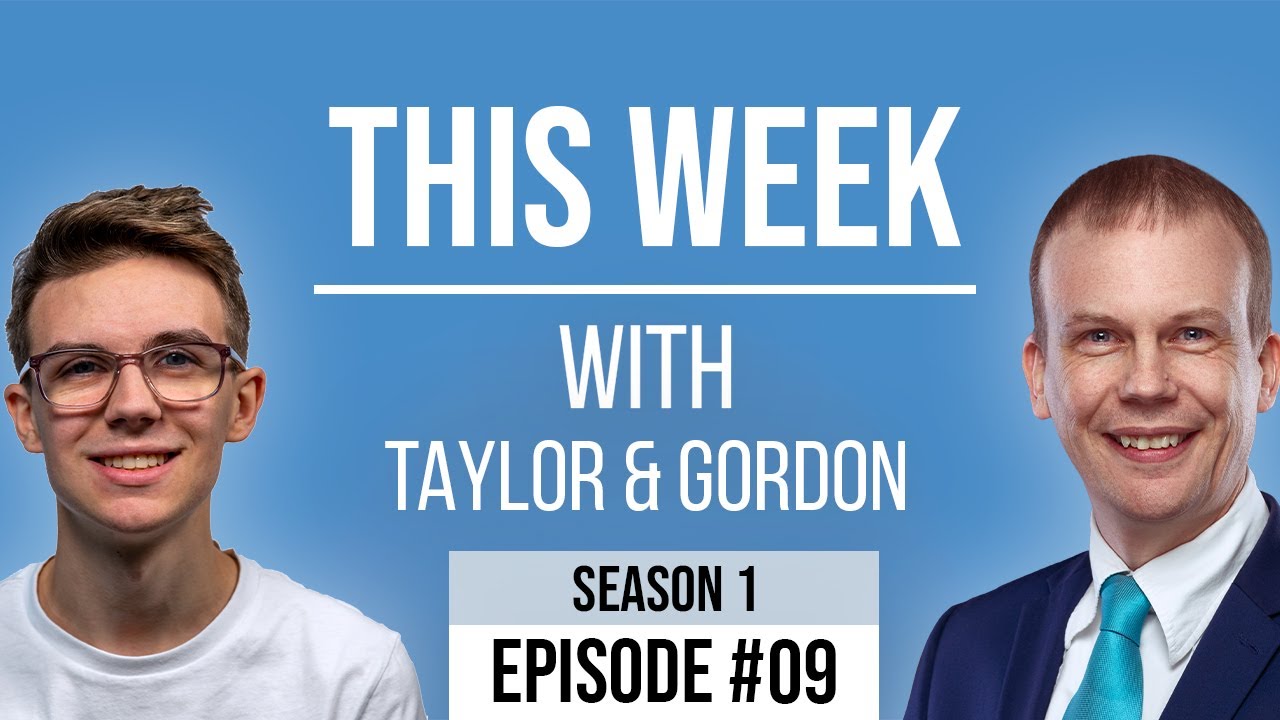
[00:00:48.580] - Gordon
Hello. My name's Gordon from Drayson Design.
[00:00:50.950] - Taylor
And I'm Taylor from The Creative Tinker.
[00:00:53.140] - Gordon
And welcome to "This Week With." So for those of you who've been with us in past weeks, you'll know that we talk about things that we've been doing during the week and any news items that we found. We've decided to make a slight change this week. We're going to spend one episode talking about my business and then we're going to spend an episode talking about Taylor's business. So seeing as I'm here and ready to go, we're going to start with me first, Drayson Design.
[00:01:27.130] - Taylor
So how did you start with Drayson Design then?
[00:01:29.330] - Gordon
It's a very good question Taylor, I'm glad you asked. So the the the reason Drayson Design started out was by mistake really, not by mistake, but it wasn't planned as such. I've been doing computers for a long time now, back in the days of the BBC Micro, which we had at school. And I really took to it; I thought it was a great little device and had lots of potential. And as a primary school student, I was the person that played with the computer the most and knew the most about it. And we only had the one, and we had different classrooms and the computer had to be taken from each class physically and then set up again. And because I knew the most about it, I was the one who got that job. So I started with computers back in the days of when I was at primary school, and it's just kept with me, really. And I was one of the first people to get a website. I got a website disbelieving.com, that was one of my first ever websites. And in fact, I bought the domain name and it was about two hundred and something pounds, which for a 'dot com' at the time was a reasonably good price. But for dot com now. Terrible.
[00:02:55.360] - Taylor
Yeah, they're about...
[00:02:57.970] - Gordon
About £57 at the moment.
[00:02:58.840] - Taylor
Yeah.
[00:02:58.840] - Gordon
That's what I'm selling mine for. And that's for two years. This was only for a year when I purchased it. And so that was a long time ago. And so I built my own website and I incorporated into my website some pages for The Magic Circle, which I was a member of at the time, because they didn't have a website, they had nothing on the internet. And I thought it would be a good idea to get something up so that if anyone ever searched for 'The Magic Circle,' they'd find some information about us. So I did a few pages, and The Magic Circle were very interested in knowing about this because they originally thought I was pretending to be The Magic Circle until I printed out... Printed out, can you believe it? I printed out pages to show them what was going on, and I was just saying I'm a member and this is The Magic Circle. And they were going, "oh, this is really good. Could you do a website for us?" And I thought, "yeah, I guess so." So I started doing a Magic Circle website, so I created the first ever website for The Magic Circle. And then I had a few more people say to me, "oh, you did The Magic Circle's website, you did your own, could you do a website for me?" And as it slowly got more and more popular, the internet that is, more and more people were asking me to do websites for them. And I had lots of entertainers who were doing it, mainly magicians. And so Drayson Design sort of created itself, if you like. I didn't ever sit down and go, "right, I'm going to start a business called Drayson Design." That just didn't happen. And in fact, I've never advertised. All of the work I've got has been through word of mouth or from people seeing what I've done in the past and going, "oh, can you do that for me?"
[00:04:45.270] - Taylor
That's really good.
[00:04:46.280] - Gordon
Yeah. So that's how it started, I mean it's changed a lot since then. [sound of running water] Sounds like somebody's just washing their hands. Really important when you're in lockdown; wash your hands. There we go. Just, the taps make a terrible sound here, do apologise about that. So that's how I started. And in fact, one other thing I did when I started was, I started making databases, because as I was using a lot of, as I was doing work for a lot of entertainers, I created my own database, which ran my business basically. So, it's a database that will take bookings, allow me to send confirmations out and basically just runs the whole thing for me. And I got entertainers saying, "how do you manage your bookings? Can you do that for us?" And I was like, "yeah, yeah, I can do that. Not a problem." So I was creating custom built databases for people, which took forever. I mean, I kid you not, they took maybe a week's worth of work working full time on it, and I just I didn't get the return on the investment really for that. I didn't get enough money. I couldn't charge a week's worth of work for that because people would never have paid it. So I only did a few of those, but that, they were hard work. And in fact my database is still going and going very strong and in fact has been upgraded a bit thanks to the automation that we've been doing recently.
[00:06:25.610] - Taylor
That's really good.
[00:06:26.440] - Gordon
Hmm.
[00:06:27.480] - Taylor
So what do you specialize in? What would you say your biggest things that you do?
[00:06:32.720] - Gordon
So I do a lot of work for entertainers and entertainment. So I do lots of photography and videography for shows, whether that be promotional videos for entertainers who want to get a promo together or if it's actual performance; either a stage show or a close-up show or cabaret, that sort of thing. So I do a lot of those. Photography as well, so live event photography, we've spoken about that last week. I have also recently been asked to do posters, so promotional posters for shows. And in fact, there's two companies that I work for and do all of their posters and publicity. So they have adverts on TVs in the venue; and they have big banners they put outside the venue; and they have some newsletters and things. So I do the posters; I do all the banners; all the flyers; all the online advertising for them; all the artwork for any print that they do. And so I do that for two companies at the moment and they have several productions a year, so that keeps me quite busy creating a look for them and a style for them for that particular show. And in fact, the last one I did for one of the companies, I did the photography for as well. So I actually went to the theatre, we took some photographs of the actual cast members and they got to be put directly onto the poster. Which is a lot more work, but I think it works really well because, just like all the big pantomimes, for example, they have all the the cast members, the famous people, on the poster, and that's what brings people in. And even though these shows are amateur shows, you still find that there are people who will go and support these and they have people they like to watch in these shows. And if they see those people on the posters, they'll go, "oh, I'll go and watch this, because that person I like is in it." So that seems to be working quite well, although we do need to sort of work out some pricing on this because it's a lot more work when I take the photos for it as well. So something else I specialize in is websites for entertainers, which I mentioned earlier. And trying to get the right feel, and look, and style for a website that suits that entertainer is something that I enjoy doing. And it's something that is important because otherwise all websites for all entertainers will look the same. And that's no good. There was a while back when there was a fashion of every entertainer, children's entertainer in particular, having a cartoon image of themselves done, with some sort of circle around them and maybe a puppet in there. And pretty much everybody that I know who's a children's entertainer had one of these done. Not me, I might add. I didn't because everyone else was doing it. So because everyone was doing it, I wanted to be different and make sure I didn't have that. So I have a completely different look and branding. But for a while, lots of people were doing this. And so all the websites that were coming out, even though they were done by lots of different people, they all looked very similar because they all had this logo, this mark, which was in the same style because the person they all went to was the same person, and he had a certain style when he when he illustrates. So finding a way to build a website that looks different when you've got very similar graphics is also quite difficult to do. But you also have to take a lead from the actual entertainer and what they do; their personality; how they wish to come across; any branding that they currently already have; that sort of thing has to be taken into account. And so, yeah, that's one of the things I specialize in. And more recently, I have been creating and collecting and making my own tools. So services, it's called 'Software As A Service,' SAAS, where you pay a yearly or a monthly fee and you have access to a service that does something for you. So for example, Online Booking Assistant, that's one of my services, and that is a yearly cost. And then we've got the more recent things like the reviews and the testimonials. And there's another new service that I've got that will be coming online soon, which I'll talk about in a future episode. So, yes, re-selling those as well. That's pretty much the bulk of my work for Drayson Design, I guess. But then I get, you know, one offs that come along doing specific documentary; or doing a specific graphic design for something; or creating or laying out a book so that that can go off to the printer; that sort of thing.
[00:11:57.400] - Taylor
That's quite nice as well, because it means that it splits up your regular work and it gives you something different to try or learn and it gives you something to learn if you haven't done it before. I know especially, I quite like trying new projects and things that I have never done before. You know, when sometimes clients come to me going, "can you do this?" And I think, you know, I have an idea of how to do it and stuff, and I kind of learn as I go. And that helps me in the future, because if then someone comes to me again, I already have a good understanding, so it's.
[00:12:26.980] - Gordon
Yeah. I mean, I would never take money from someone whom I didn't think I would be able to do a good job for. So I would have to, in the back of my head, I would have to know that I'm capable of doing it, even if it's something I haven't necessarily got experience with in the particular way they want it. I must have experience in other ways so that I know that I'm going to be able to fulfil the contract.
[00:12:51.700] - Taylor
So normally what happens is people will come to me and go, "can you do this?" And I know, like in my head, I know the logic and stuff but, and I've seen other people use it, and I've, I'm in like a bunch of forums and stuff, so I see people talking about it and stuff like that, so I know it's possible...
[00:13:05.270] - Gordon
And we know that we've got other people we know who are experts in their field that should we run into problems, we can go to them and say, "right, look, I've got a little job for you. Can you help me with this? Can you do this?"
[00:13:16.660] - Taylor
Yeah.
[00:13:16.900] - Gordon
"Can I just pass this bit over to you? Because you can do it quicker than me." We've built up a good, what's the? Community of professionals who have their own expertise we can call on as and when we need to, which is always good.
[00:13:32.630] - Taylor
Yeah, definitely. So how have things changed since you started Drayson Design to now I guess.
[00:13:40.660] - Gordon
So, it's changed a lot. As I said, I was one of the first people to ever get a website. And in fact, I've got some very early business cards which we'll display on the screen now for you.
[00:13:54.430] - Taylor
If you can find them.
[00:13:55.510] - Gordon
No, we've got them. All lined up. Yeah! Live show. You've got to have them ready. There you go. So, you can see them now. And yeah, so they look very different. If I show you my recent business card here... You can see that it's changed a lot. Yeah. It's just, the very fact that the internet itself has just boomed. The people that you would never think would have internet access, like grandparents, for example, new technology, that sort of thing, why would they need that? But they do. I know pretty much, everyone I know, pretty much everyone I know, has internet. My uncle doesn't, but he's chosen not to, that's basically his choice. But everyone else I know has got internet, and that wasn't the case before. When I started out, I was the only person I knew with internet. And it wasn't even broadband. It was a modem, you used to... Originally it was a phone coupler. You used to dial the number on a rotary phone, ok, way before your time. Once you hear the tone, you put it in an audio coupler. If you've seen the film "War Games," you'll know what I'm talking about. And that would then take the sounds and convert them into, take them down a signal into the computer and convert, the computer would then convert those sounds into data. And that's how it was. And when I started out, I was on a bulletin board system, which meant you dialled in... It, the computer then sent your messages; received new messages; logged you off. You would then read those messages; you'd reply to them, offline; you would then log on again and you would send your new messages; download any new messages. And it meant that no one else could use the phone because if they picked it up at the time that you were sending and receiving messages, they'd hear this horrible sound. I mean, it's just, if you've ever heard it, you'll know what I mean. And the number of times that my parents would just pick up the phone because they needed to make a call and they'd hear me and they'd shout, "Gordon, get off the phone, we need to make a call." It's like, "yeah, well, I'm off now because you've just hung up my connection." But I mean, the connections were never long. They were sort of, you know, two, three minutes at a time, but they were, short periods, but they were, they happened a lot. You know, they would happen three, four times a night if I was, you know, talking to people. And then we got given an email address. It's like, wow, we got an email address. Why do I need that? I didn't, I couldn't understand why I needed it, because at the time it was just a small community and you used to log in and everyone was on the one bulletin board system and that was it. You talk to the people who were on the system that you'd chosen to subscribe to. And it was a subscription, you had to pay money to be on there. And then they came and they said your email address can now be used to communicate with other bulletin board systems around the world. It was like ok that's, so hang on, I can send a message here and my friend who's interested in computers in Canada, he can pick up that message and send it back to me, and it's not a phone call, it's an actual, a message? I thought, "right, ok, I'm starting to understand how this email could be interesting." And then websites came along. So, yeah, it's really interesting how it's changed. I mean, a picture, to just download a picture used to take seven minutes. Seven minutes to download a very low res picture in today's terms, and now I'm recording video, you know, on phones and on mobile devices, you know, they're just, and they're instantly going onto computers. It's just very, very different. And as a designer for websites and photography and videography, all of those have changed so much in the time that I've been doing it. Learning how to do something, you had to get your hands dirty, you had to just get a book from the library, buy a book, learn how to do something, teach yourself HTML. I mean, no one codes in HTML these days. A lot of people have a good understanding of it, but there's so many tools out there you don't need to learn it anymore. You just need to go and find a tutorial that will teach you how to do the little bit you need to do. And you can do that on YouTube, you know. No such thing as YouTube when I started. So, yeah, it's changed a lot. And in fact, it's one of the things that I am finding really interesting in the job I do, in the fact that it does change constantly.
[00:18:59.460] - Taylor
Yep.
[00:18:59.460] - Gordon
I don't mind re-learning stuff. I don't mind learning a new tool because something new has come along.
[00:19:05.580] - Taylor
Or more efficient.
[00:19:06.840] - Gordon
More efficient, yeah. I learnt Flash at one point and then Flash, Adobe Flash that stopped and we've now got HTML5, which I don't need to learn because you've got drag and drop builders that will do these things now. It's that that keeps the interest in the business for me, the fact that I can continue to grow and help all my customers, you know, a new technology will come along that will be of interest to them, even though they may not know it. And I can go, "did you know that this is now possible? You can do it yourself, I can do it for you, whatever," you know. And yeah, I'm really enjoying that part of the job, really enjoying it.
[00:19:50.340] - Taylor
That sounds good. Is that everything then?
[00:19:51.610] - Gordon
Yeah, I just, I guess the only thing left to tell you is how you can get in contact with me. So if you're interested in anything I've spoken about or you have memories or opinions on anything that I've said, then your first port of call would be to leave a comment, that's either on Facebook or YouTube, where we are live streaming. We have thisweekwith.co.uk, which is our website.
[00:20:17.760] - Taylor
Yeah.
[00:20:18.660] - Gordon
You can go on there and you can view the videos after they've been completely rendered by YouTube. And we've got my own website, Drayson Design, so draysondesign.com. It's currently showing a waiting page, and that's only because I'm still building the site, basically. However, if you would like a sneaky peek at my new website, now bear in mind it's not finished, it's work in progress. The home page in particular has got lots of placeholder stuff. So if you go and have a look and you see the home page, don't judge me on that. That's still being worked on. There are lots of other things in there: the portfolios, the service pages, that sort of thing. They are all being worked on one by one and some of them are complete. So you can you can view it by going to draysondesign.com/home. And that will take you into the site so you can go and have a look, and basically see how it is I'm building the site. So if you're interested in that sort of side of it, that could be of interest to you. If you're watching this video or listening to this podcast and it's, you know, seven, eight months... Well hopefully not any where near as long, you know, two months from where we are now, from the publishing date, then don't bother with the /home, you can just go to draysondesign.com. Love to hear your comments and opinions. Please leave them and let us know. I think that's everything.
[00:21:57.190] - Taylor
Yeah.
[00:21:57.580] - Gordon
So that's all about Drayson Design. Uh, thank you so much. If you've got this far for listening. If you have enjoyed it, my name's Gordon and I am from Drayson Design.
[00:22:09.550] - Taylor
And I'm Taylor. I'm from The Creative Tinker. So you can find us on all the social medias or most social medias, YouTube, Facebook and things like that. And yeah, we'll see you next week.
[00:22:21.820] - Gordon
And we will be talking all about The Creative Tinker next week, which is Taylor's business. So come back and hear all about his business. Until next week, it's goodbye from Gordon.
[00:22:33.730] - Taylor
And it's goodbye from Taylor.
[00:22:34.990] - Gordon
Goodbye everyone.
[00:22:35.620] - Taylor
Bye.