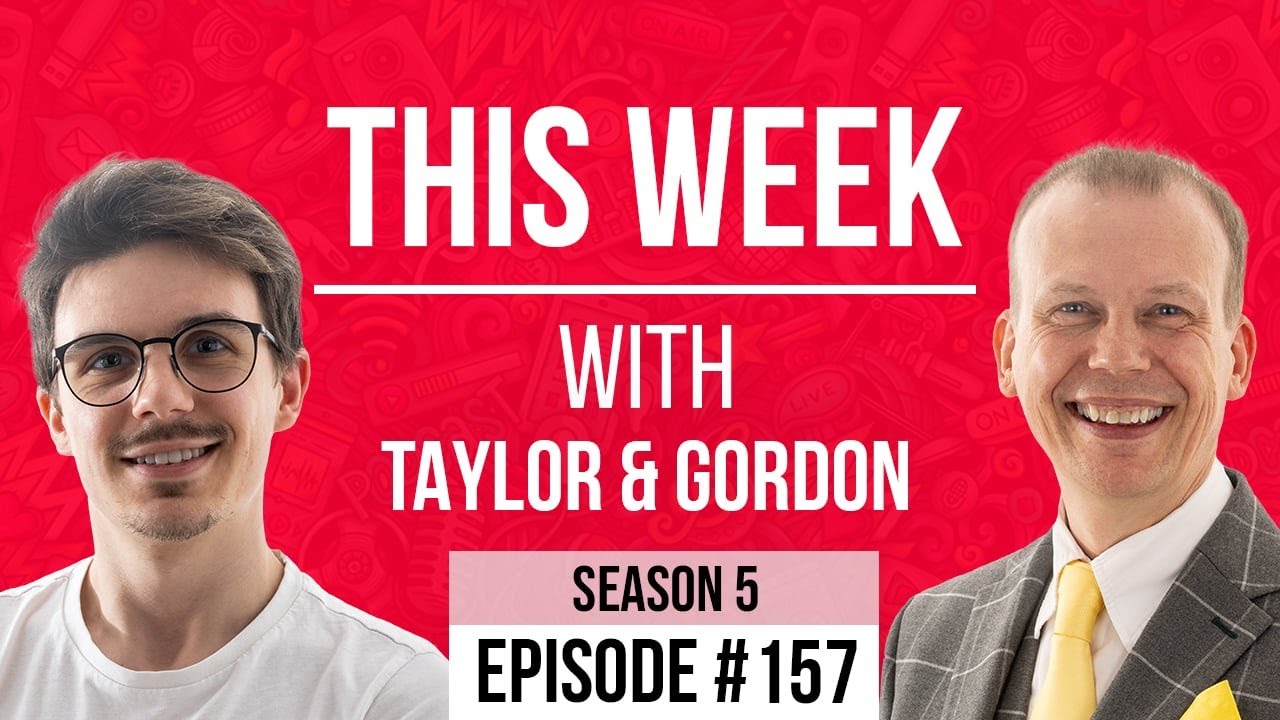
[00:00:09.280] - Gordon
Hello.
[00:00:09.620] - Taylor
Hello.
[00:00:09.970] - Gordon
My name's Gordon from Drayson Design.
[00:00:11.740] - Taylor
And I'm Taylor from The Creative Tinker.
[00:00:13.910] - Gordon
And welcome to "This Week With Taylor and Gordon," a weekly podcast and vidcast where we talk about things that have affected our businesses over the last seven days. It's one o'clock and it's Friday. Thank you for joining us. It's been a busy week, as always.
[00:00:29.540] - Taylor
Yeah.
[00:00:30.110] - Gordon
People have been back to work, back to school, which means that there's a little bit more normality as far as work goes. You're able to contact people now without them being on holiday or away. And we're here as well, which is also good. So let's get straight into our topics. Shall I go first?
[00:00:52.630] - Taylor
Yeah.
[00:00:53.710] - Gordon
So today, I think we've mentioned this in the past, but it's worth repeating. How to manage your time. What to spend your time doing. So this is something that a lot of people, especially people who work for themselves, struggle with. You flit from one thing to the next, and it's the next new shiny object, and then all of a sudden you get sucked into a YouTube video, and then four hours later, you're still watching YouTube videos, and you find that the end of the day comes and you've not actually achieved anything. So finding your tasks that are important and setting daily goals. I'm not a big goal setter. I've never worked towards goals. It's not something that works for me. But short term goals I'm good with. So everyone has deadlines. If you have a deadline, you know you need to get that job done by a certain time, and then it becomes important and you get it done. Quite often, you get it done because there's a deadline. And so if you give yourself your own deadlines and make sure that you believe that they're important, then you'll end up getting the work you want to do done in the time that you have available. Because work does expand to fill the time available sometimes. You can start a project, and because there's no urgency to it, it could take months and months or years to actually come to fruition. But if you've got a specific event that you are going to be talking to people about this project, or you've got a client that's going to be waiting for it, and you don't want to keep them, there's no set deadline, but you don't want to keep them waiting too long, and you give yourself your own deadline, then you'll be able to make sure you get it done in time. The other side of this is to make sure that you use your time wisely. What I mean by that is if you've got deadlines, obviously that's going to be the work you're doing. If you haven't got deadlines and you've got not much work or you're trying to do some admin or some marketing, make sure you're using your time to the best that you can with the time available. So don't use it frivolously, I think is pretty much what I want to say here. Don't look at things and go, "it would be lovely if we did this. There's something else that's more important, but it would be lovely if we did this." Do the thing that's more important. And then if you've still got time left, then you can do the thing that you would like to do. This is something that we've worked to, something I've worked to and something I brought you up with, which is do the things you have to do, then do the things you want to do. And I think if you live by those rules, I mean, loosely. I mean, normally the have to do's are, not urgent, but you do have to do them. So it's always good to do those first, get them out of the way, and then whatever time is left is your free time, effectively. And also put time aside for yourself. When you work for yourself, you quite often work every day, weekends included, bank holidays included. Put some time aside to actually have some downtime. We've spoken about that in the past, and that's really important. So that's pretty much it. That's all I really wanted to say. Just use your time so that it's productive. And what you spend your time doing is going to be different for every person. What's important is going to be different for every person. What might be seen as wasting time for one person is actually really important for another person, depending on what their aims are, what their achievements that they're looking to get are, or the outcomes that they're looking for. But have a look at it, have a think about it. Look at the tasks you have ahead of you and make some decisions. What order should I do them in? Make yourself a list in the morning. In fact, I don't think the morning is the right time to make a list for what you do in the day. I think the night before is the time to make a list of what you're going to be doing the following day because your brain spends the night subconsciously thinking about all the things that you've put on your list. And so when you get up to start them, you've already done a huge amount of thinking about it without even knowing. And it makes you much more efficient. There was a very old phrase that says, "If you want a job done, give it to someone that's really busy," which doesn't sound quite right. Why would you give it to someone who's really busy? But the thing is, someone who's really busy is normally much better at managing their time than someone who's not busy, because the fact that they're not busy means they haven't managed their time and they're not getting much achieved. They're not doing a great deal. And by giving them a job, it's just another job for them to do at some point, whereas someone who's really busy will prioritise it, decide where in that priority it's going, and it will get done. And that's why you do that. And so I think that's pretty much all I wanted to say about that. Anything you want to add on that before you go into your topic?
[00:06:32.850] - Taylor
Not really, but my topic is sort of related to what you were talking about.
[00:06:38.230] - Gordon
Let's go straight into that then.
[00:06:39.560] - Taylor
So my topic is being purposeful with your scheduling and how you run your days or weeks. What I mean by this is I try and go to the gym three times a week, and what I find is on a Sunday night to Monday morning. So Sunday night, I will get my gym clothes ready out on my bed, ready for Monday morning. I find that Monday morning is probably the most productive day I ever have, and that's just because I have planned the night before, my clothes are out, this is what I'm going to do tomorrow morning. I'm going to go to the gym, and that sets me up for the day.
[00:07:23.400] - Gordon
And that's an early morning gym, isn't it? So it wakes you up and gets you ready for the day ahead.
[00:07:27.990] - Taylor
Yeah. And what I found is, if I don't set my clothes out the night before, I haven't in my head said to myself, "I'm going to the gym." I've kind of said, "If I'm awake, if I get up in time, I'll go to the gym." And I've found every single time that I haven't said to myself, "I'm going to the gym," I don't end up going. If I ever go, "I'll see if I go." I just don't go. And I find that when I'm scheduling things now recently, I'm very careful and thinking about when is the best time to schedule the work. For example, I have a PT once a week, and scheduling it on a Monday would be pointless because I have enough motivation for myself on a Monday that I don't need the extra boost to go to the gym, for example. Whereas on a Friday when I have my PT, I would probably very easily skip my PT session, my gym session, sorry, had it not been for my PT sessions. Because I'm paying for them, it's an incentive for me to go. I'm like, "Well, I don't want to waste the money," so I go. And I've been going every Friday pretty much consistently for the past couple of months and things. So it's very good to think about the tasks that you need to do, but also when to prioritise them, because you're going to have more energy at certain times of the day, you're going to have less energy other times of the day. So it's-
[00:09:00.950] - Gordon
And it's the same during the week as well, isn't it? Your energies changed during the week.
[00:09:06.360] - Taylor
Yeah. So if I go really hard Monday and Tuesday, the tail end of that week normally means I end up slacking because I've done so much work in the beginning. So it's also managing how much you're working as well, because if you do so much in the beginning of the week, you're not going to have any energy for the rest of the week. So it's just thinking about when is the best time to schedule whatever you're looking to do. I have a bunch of recurring jobs, tasks, that I do every week, and I'm looking at them and thinking, "Is this the best time?" Sometimes I'm doing stuff, I'm resenting having to do it. And I've changed one or two things around recently, and it's like, "oh, I actually don't mind doing it if I do it straight away or if I do it at a different time of the week." So yeah, definitely something to think about and how you can use just your general week, your recurring stuff, and how you can use that to your advantage of when you've got the most energy, when you haven't got much energy, and just playing off that, really, to help not so much be productive, but just be able to keep yourself accountable and continue going on with it so you don't get burned out. You are able to sustain it for a long period of time.
[00:10:27.700] - Gordon
I think accountability is a big part of this. I had a friend of mine that I used to go swimming with on a Wednesday in the early evening every week. And sometimes, hump of the week, you're getting towards the weekend, but you're not there yet. You've still got another two days to go. And sometimes I just felt, "Do you know what? I just don't want to go swimming tonight. I just don't fancy it. It just sounds like a lot of effort." But because I was going with someone and either I had to pick them up or they had to pick me up, I ended up doing it because I felt that I would be letting the other person down. So the accountability was that we were helping each other because I'm sure he had the same thoughts. "I don't want to go to the swimming pool today, but I will because I've already said to someone I will and I don't want to let them down." So I think accountability is a good thing. And this is one of the things I do on a Wednesday at the moment. I've got, Paul, my double act partner, who I think we've spoken about and has been on the podcast, in fact. And he and I try and meet up on a Wednesday, remotely, so it's on Zoom these days, and we have a list of things that we want to get done, basically. And between the two of us, we will help and push each other to get those bits done. And without that push, I'm not sure that quite as many tasks would be completed. And the reason for doing it on a Wednesday is because, as you said, beginning of the week, you're all fired up, ready to take on the challenges of the new week. And then come halfway through, you're thinking, "I might have burnt myself out a bit too much, but I have to go because I've told someone else I will." So yeah, it works really well, accountability.
[00:12:33.010] - Taylor
We have that for the cinema. I don't think we would go, or I would go to the cinema as much as we do if it wasn't for going with you, because I could very easily make up an excuse going, "I'm too busy. I can't set aside time to actually relax and do something for myself." And so that helps because it's like that's something we do together and you're looking forward to it. I look forward to it and sometimes you don't feel like going, but you know that when you do go, it's good because you have to give yourself a break.
[00:13:04.860] - Gordon
We saw Back to Black this week, didn't we?
[00:13:07.210] - Taylor
We did.
[00:13:07.740] - Gordon
The film about Amy Winehouse, a bit poignant, I think we decided. Came out. But it told us a lot about her thought processes and why she did certain things the way she did them. So, yeah, we quite enjoyed it, didn't we?
[00:13:21.400] - Taylor
Yeah.
[00:13:21.640] - Gordon
Yeah. If you've seen the film, let us know what you think. If you are someone who doesn't have an accountability partner, in any way, maybe try it. Just see how it goes, whatever it may be, whether it be having downtime, like going to the cinema, or whether it be doing your accounts, or whatever the task is. Just find someone that you can be accountable with. It needs to be someone that you do the task with rather than just telling them that you've done it because that's something that you can just turn around and say, "Yeah, it didn't happen this week." But if you actually have to go and do it with them, it normally does get done. There are exceptions. If there's emergencies that happen or very late deadlines that you have to deal with, then things can change. But on the whole, accountability is a really good thing.
[00:14:19.770] - Taylor
Yeah.
[00:14:20.890] - Gordon
That's it from me.
[00:14:22.070] - Taylor
And me as well.
[00:14:22.970] - Gordon
Thank you for joining us. As always, you can find us on Facebook and on YouTube. Please like, share, and subscribe.
[00:14:30.210] - Taylor
You can also go to our website thisweekwith.co.uk to find all of our past episodes.
[00:14:35.380] - Gordon
And we are on all the normal and favourite podcast platforms. So you can find us on Apple Music or I believe we're on Spotify. If you find one we're not on, let us know and we'll see what we need to do to get on there so that you can listen to us on your favourite platform. I think we're on most of them though.
[00:14:55.560] - Taylor
Yeah.
[00:14:55.740] - Gordon
Until next week, 1pm on Friday. My name... Oh, no, no, we may not be able to do it. I think you're away. We'll do it if we can, but if not, then it'll be the following week. We'll see you then. My name is Gordon and I'm from Drayson Design.
[00:15:12.470] - Taylor
And I'm Taylor from The Creative Tinker.
[00:15:15.100] - Gordon
Goodbye.
[00:15:15.400] - Taylor
Bye.