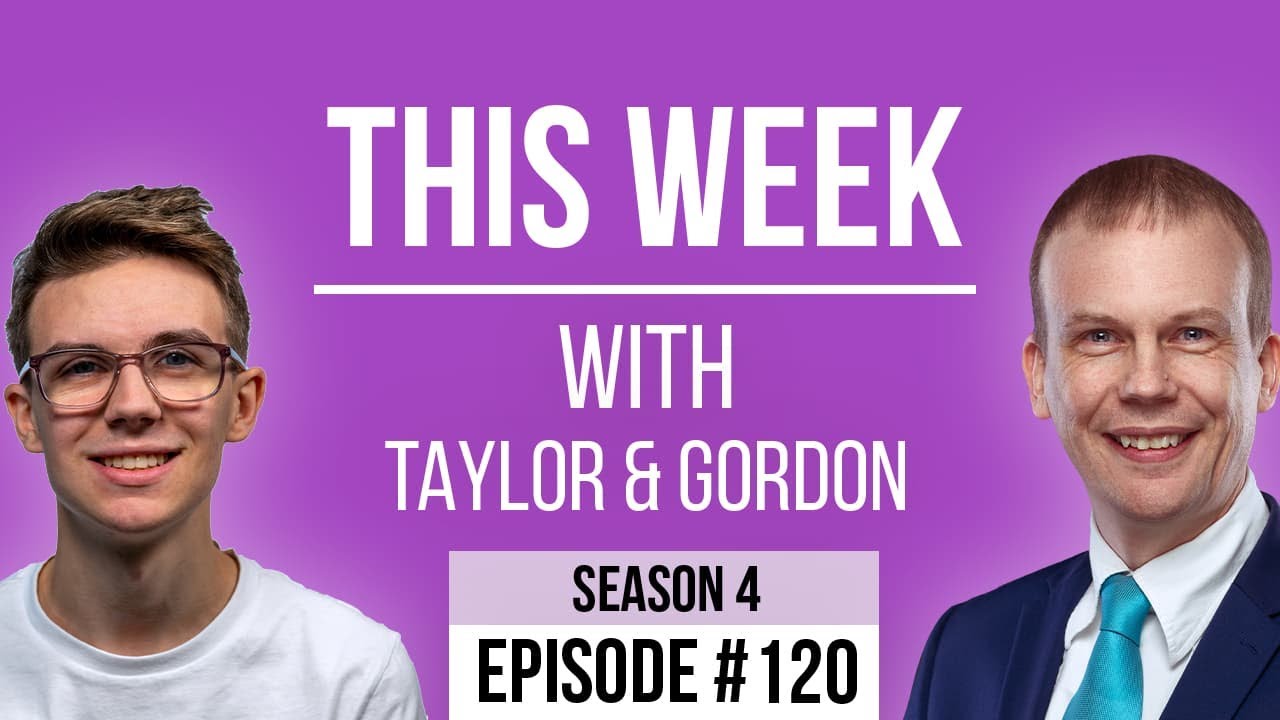
[00:00:09.320] - Gordon
Hello.
[00:00:09.600] - Taylor
Hello.
[00:00:09.930] - Gordon
My name's Gordon from Drayson Design.
[00:00:11.700] - Taylor
And I'm Taylor from The Creative Tinker.
[00:00:13.590] - Gordon
And welcome to "This week with Taylor and Gordon," a weekly podcast and vidcast where we talk about things that have affected our businesses over the last seven days. And welcome back to those who've been with us before. I apologise about my voice. I've got a bit of a sore throat at the moment, which makes it all a little bit odd. But it's actually getting better, isn't it? Over the weekend, a few days into the week, it was sounding horrible. But now it's getting back to normal, which is just as well because tomorrow is a very special day. Tomorrow is the coronation of our new king. And that's the first coronation we've had here in the UK since Queen Elizabeth. And I wasn't around for that. And I don't think my parents were around for that. They might have been actually, but only just. So yes, King Charles the third will be coronated tomorrow. It's exciting, isn't it?
[00:01:17.610] - Taylor
Yeah, big event.
[00:01:18.740] - Gordon
We've not had a coronation here in my lifetime and definitely not in your lifetime. So yeah, very exciting. The UK do pomp and circumstance very well. So it should be a good event. We shall see.
[00:01:33.090] - Taylor
We will.
[00:01:34.390] - Gordon
So any news, first of all?
[00:01:37.090] - Taylor
Not from me.
[00:01:37.850] - Gordon
Okay. Can I go first today?
[00:01:40.630] - Taylor
Yeah.
[00:01:41.430] - Gordon
So last week I was talking about hard drives and how the important thing is to make sure you look after your data. And then a day or so after that, the system I was using, the NAS system, which stands for?
[00:02:00.110] - Taylor
Network Access Storage.
[00:02:02.050] - Gordon
Exactly. Yeah, no it is. I got it wrong last week. So it's Network Access Storage. The system I've been using just failed on me, which was a major pain in the backside because all of the data is in a particular format and you can't just take the drives out of one box and put them into a completely new box that's made by another company because it just won't work. And I can't put them into a new box from the company that is currently the one I'm using, which is Drobo, because, well, January they went out of business. So they are no longer doing support. They are no longer selling anything. So I can't replace the drive, the box, sorry, the enclosure, and I'm left with these drives that I can't get the data off. So the last week has been me trying to figure out how I'm going to get the data off these drives so that I can rescue them because it's the only place I have this data, which is a problem, and it's one that I'm going to look to solve once I've sorted it. And also, what am I going to replace it with? I don't want to use the same system because the company no longer is in existence and therefore, they're not going to be doing any updates to the software. And it was always a concern for me that the software hadn't been updated to work with the current operating system. So that was an issue for me. So what I've decided to do is go with a company called Synology, and I've bought a DS 1522 plus. Now, this is a five bay NAS system, which is great because I've got five drives, so I can just, once I've taken the data off these drives, I can repurpose them, put them into the new NAS, and I can then start my data transfer over to them again. So that I'm effectively back where I was about a week ago. So the issue I've got is getting the data off. I need to have the drives all online in one go because otherwise, I can't access the data. So I've got a box that does that. I've also had to spend money out on a software that is supposed to and it hasn't quite worked yet, it's supposed to find all the data and allow me access to it so I can copy it off the drives into somewhere else and then back on the drives once they're in the new system. That's about £140 worth of software.
[00:04:42.590] - Taylor
Okay.
[00:04:43.660] - Gordon
My problem is, because it's such a large, raid system, the time it tells me it's going to take is about 257 hours.
[00:04:57.660] - Taylor
That's a long time.
[00:04:59.940] - Gordon
That's a long time. It's like 10 days, 11 days, which is a huge amount of time. And the software that I'm using is Beta because it works better with the system I've got. But it's Beta, which means that every now and then it's going to crash and I'd then need to hope and pray that I've got enough saved in there to then carry on where I was instead of having to go back to the start and do it again. But yeah, it's going to be a long process to recover my data and I don't want to be in this situation again. So the new software that I've got, the new Synology I've got has great software. For a start, it allows me to access all of my data over the internet if I wanted to. And it's reasonably secure. The videos that I've been watching are experts on this system and they use this system. So it's reasonably secure. But you also have the ability to spend more money. This system was just over £700 just for the box, just for the enclosure. So it's a big investment that I didn't know I was going to need to make. But you can also buy an external standalone hard drive in its own case, which is USB and you can plug the USB into the NAS drive, and there is software on there called Hyperdrive, which will automatically back up the data onto that external drive so that you've got a second copy of the data. So that if anything happens to your NAS or the drives within, because it only works if one of the drives fails at one time. You can take that out, you can replace it with a new drive. It will rebuild the data. But if anything fails during that rebuilding, or you have more than one drive fail originally, then you lose data. It's simple as that because they're only on two drives. All the data is on at least two drives, which gives you the ability to lose one drive. However, if you've got a backup that happens every night and goes on to this external drive, which again is another £300 ish, then you should be okay because you've got your data in two places. The backup recommended policy is the 321 system. Did you know about this?
[00:07:28.460] - Taylor
I've heard about it.
[00:07:29.950] - Gordon
So it means that you should have three backups of every file that you need, two different formats - so that would be a hard drive and a tape or cloud, something like that, and one backup that's off site. Now, I'm not going to do that. I'm not going to quite get that far because even though I don't want to lose any of my data, it's not mission critical. If I lost my photos, okay, that would be a really bad thing because I'd lose all my photos. But I do have backups of my photos on Flickr. They're not in raw format, which is what I have them in normally, and they're in Lightroom and I would lose that, but they're on Flickr and I would still have access to the JPEGs of my photos. So I'm not going to go that far. But what I am going to do is I'm going to get this external drive and I'm going to make sure I do a backup. So I have two backups of every file and the NAS, which will have a third backup, if you like, because every file is going to be on two drives. But yeah, it's been a stressful period because there is data on there that I only have on the NAS. And by not having it, it's very stressful because you wonder, "am I going to live without that data?" And you then start thinking to yourself, "what was on it?" Because you're so used to being able to access it every day, you just forget what's actually on that drive. So you forget what you're actually going to lose. And all this started out by one drive failing and it snowballed and I've ended up spending over £1000 so far, and I'm not finished yet because I still need to get this external drive. But by the end of it, I will have, hopefully, a solid system. Well, I'll definitely have a solid system. It's whether I'll have all my data. I'll get back to you and I'll let you know. Look, I'm even smiling when there's a potential of losing over seven terabytes worth of data. If you don't laugh about it, you cry so yeah, look after your backups, have a system in place, really important. What do you want to talk about, Taylor?
[00:09:53.340] - Taylor
So I've been reading more recently, and I was recommended a book by White Panther or Salma Alam-Naylor, who is a developer advocate for Netlify. And she recommended a book called "Make Time." Now, it's a book by Jake Knapp, I think. KNAPP, I think. And it's all about making time to be able to do the things you want to do. So whether that is doing the project that you say you someday will do, and making that someday be a day in the near future. Or whether it's finishing work that you've been meaning to get around to, or doing the chores, or things that you want to do, but you've never had time. And I've only just started reading it, but I thought I would share with you the first idea and process that they recommend. So there's three parts to it, and then they give you steps and things that you can do for each, all three of them. And they don't say all of them will work. They don't recommend you do all of them. But they recommend each day you pick one of the ideas, try it out, see if it works for you. If not, then try and change it slightly until you find something that works for you. And it was written by these two guys. And again, there's different methods to the three different parts to it. And again, they don't work for both of them. The same things don't work for each other. So what works for one of them doesn't work for the other. And the first part is a highlight. So they say at the beginning of the day, write down one thing that you want to get done. Now, this could be a piece of a task you need to get done. It could be you want to make a start on a project you've been meaning to do, or it could be making time to spend time with your family, for example. He says, pick one thing at the beginning of the day, and that's your highlight. That's your highlight. So if someone was to say to you at the end of the day, "what did you do?" That would be what you'd want to tell them. And so I'm only a couple of days in and it's starting to go well. I've been getting the things that I've wanted to do or have been meaning to do work wise, at least to begin with, and I've been able to do them. And it's allowed me to focus because instead of having 10 different high priority things, I'm thinking, "Okay, well, I want to get this one thing done. And as long as I get that done, then that's a success for me and a good day. If I get more than that done, then that's great. But that's the one thing that I want to do." And it's a really nice idea. And there's lots of different ways you can go about it and things like that. But it makes you think and dedicate, make sure that one thing you kind of get done. And the reason, the way they came up with it, they did a lot of experiments about the best solutions, the best way. And they found that setting vast goals, so yearly goals, so what's your year, five year, 10 year goals, they were too broad. And should your goals change, you end up thinking, "Have I just wasted all this time because my goals have now changed." But they also found that, were you making minutely tasks, they were too minute and you just ended up spending your whole time just writing tasks down and ticking them off pretty much instantly. And so they found this balance where if you set it as a day, per day, you just set one task or highlight, as they call it, then that's the nice balance between. You can still have your breakdown of tasks, so you could say, "I want to get this PowerPoint finished." And obviously within that, you're going to have multiple tasks. But the highlight for the day is to get the PowerPoint done. And you're still going to have your long term goals of where you want to be, things you want to do. Again, whether that's personal or both work. But by breaking it down into your highlights, it's a bit less overwhelming, I think. And then there's another two steps to this way of working. One of them is laser, which talks about... Again, I haven't read too much into it, but a high level is a bit about how we can reduce distractions and how you can... It's basically laser focusing, so how you can focus on your highlight for the day and make sure you get it done.
[00:14:49.200] - Gordon
So do they suggest how big a task you set? Because obviously your one highlight task could be as small as reading a one page document. It could be as big as, I don't know, building a website.
[00:15:06.600] - Taylor
Yeah. So they said that it should take a minimum of about 90 minutes and a maximum of about two hours.
[00:15:14.540] - Gordon
Okay.
[00:15:15.020] - Taylor
So, yeah, you have that. Like I said, it's not a very small task, but it's not a huge task where it's restructuring an entire company, for example, which you can't do in a day. But it's not small enough that it can be ticked off in five minutes. So it's a substantial task that, again, you could break a bigger task down. So if it's finish a website, it could be finish a page, and that could be designing and then developing it, or it could be finishing the main pages. So if you've got a five page website with lots of sub pages, it could be just getting the main five pages or building out the main theme of the website, for example. So you've got all your global colours, setting up your typography, all the things like that, your header and footer, and all of the global stuff. So you've got to break it down to something that is manageable and realistic. But it's something that is a minimum of at least an hour and a half to two hours.
[00:16:11.670] - Gordon
And I guess there's nothing to stop you creating a list of these one and a half hour to two hour tasks. And then at the beginning of the day, you can go, "Right, well, I'm not sure what I want to do. Let me look at my list. I'm going to pick that one because I think that's important." And then you could make that your task for the day.
[00:16:32.430] - Taylor
So they said there's different ways for you to determine what your highlight is. So it could be that it's just based on which task is due the soonest.
[00:16:44.090] - Gordon
Priority.
[00:16:45.050] - Taylor
But it could be something, you know if you've got a... They mentioned that these 'someday' projects, they're very, very difficult because they have no timeline, they have no deadline. And so it could be that you wanted... It's more of an emotional type thing. You want to start on this project and that's how you're going to choose it. And again, these highlights don't have to be work related. They could be, "I want to cook dinner this evening and spend time with the family," for other people that are in their middle age and have a family and things like that to look after and things.
[00:17:19.830] - Gordon
It doesn't have to be middle age, though. It could be, I don't know, a son who decides he wants to cook dinner and spend time with his family. That could work, couldn't it?
[00:17:29.540] - Taylor
You'd get frozen pizza, so I don't think that's what you want. But yeah, it doesn't have to be work related. And that's, I think, the best part of it is it helps you, like the book mentions, make time to be able to do the things that you want to do and these 'someday' projects.
[00:17:46.420] - Gordon
I think that's the problem. When you work for yourself and you don't have anyone else around you, you've got to create your own impetus to actually get stuff done, right? Because you could so easily just start watching a YouTube video and then find that your whole day has disappeared because you just ended up going down a rabbit hole, and you've watched YouTube all day and nothing's actually been done. Whereas if you've got other people around you, it gives you that push to go, "Right, well, I can't just sit and watch YouTube because people are going to watch me. They're going to think I'm lazy. I've got to get on with stuff." So it's much more difficult when you're on your own or self-employed, right?
[00:18:28.910] - Taylor
Definitely. And I think, I remember on I think it was Tuesday, I had a project that I should have finished or I should have submitted to the client a long time ago and I had just been putting it off. Not because I didn't know what I was doing, but just because it's one of those projects where I needed to get it done, but it was just building out a website, standard thing. And I set my highlight to submit a first draft of the website to the client, and I finished that about midday or so. And the rest of the day, I didn't get too much work done, but I felt accomplished because it was something that, again, it's been on my list for a very long time and just hadn't got round to doing it for multiple different reasons. And I felt very accomplished. So even though I didn't get tons done that day, I did get quite a big thing done.
[00:19:24.290] - Gordon
A small step forward is still moving in the right direction, right?
[00:19:28.210] - Taylor
Exactly.
[00:19:28.920] - Gordon
Yeah. Rather than than just standing still, or even worse, going backwards. Yeah.
[00:19:37.560] - Taylor
Casey Neistat did a great representation of a short video on a quote which was about, "if you're not moving forwards, you're going backwards." And the whole idea behind it was a travellator where you're walking. And if you're... To get ahead, you've got to run and hustle in a way. Because if you don't, you just end up in the same place. And if you don't do anything, you end up going backwards. So it was kind of, you know, you've got to put the hard work in to get ahead in life and to get your project done and move up in the world, whatever your ambitions are and whatever you define as success. But you've got to run and put the work in to get that. Otherwise, you just stay in the same place, or even worse, you end up going backwards.
[00:20:30.400] - Gordon
I think that's very important. Otherwise, you're never going to fulfil your career goals, are you?
[00:20:36.700] - Taylor
Yeah.
[00:20:37.270] - Gordon
So yeah, very interesting, Taylor. I look forward to hearing more as you read it through. Maybe one of your highlights will be to read a chapter. At some point, that will be a highlight and then get it done. Fantastic. It's quite funny actually setting a highlight to get through a book that's telling you how to manage your time better. That's really funny. So that's it for me.
[00:21:03.190] - Taylor
And me as well.
[00:21:04.110] - Gordon
Thank you so much for joining us. If you are watching the coronation tomorrow, then I'm sure we will be as well. So it's a very exciting time for us here in the UK. And in some ways, I find Americans really enjoy it as well because of the way that the UK does these things with all the... It's a very military organization of these sort of events. It's a big thing for the UK. So if you are watching that, then I shall be watching it along with you. And please join us again next week. As always, we can be found on YouTube and on Facebook. Please like, share, and subscribe.
[00:21:46.120] - Taylor
You can also go to our website thisweekwith.co.uk to find all of our past episodes and also see the show notes and links to anything that we've spoken about.
[00:21:55.210] - Gordon
So enjoy your weekend and we look forward to seeing you with us next week, Friday at 1pm. Until then, my name is Gordon and I'm from Drayson Design.
[00:22:04.900] - Taylor
And I'm Taylor from The Creative Tinker.
[00:22:07.760] - Gordon
Goodbye.
[00:22:08.240] - Taylor
Bye.