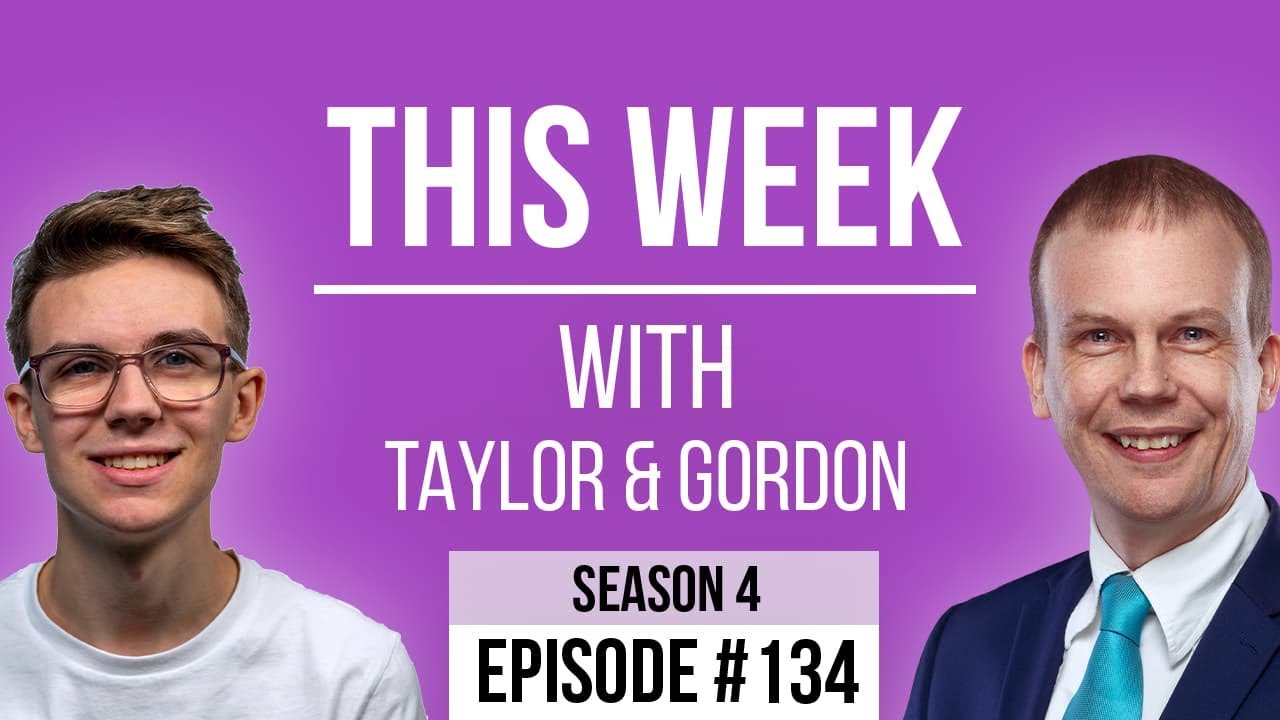
[00:00:08.820] - Gordon
Hello.
[00:00:09.140] - Taylor
Hello.
[00:00:09.300] - Gordon
My name is Gordon from Drayson Design.
[00:00:11.190] - Taylor
And I'm Taylor from The Creative Tinker.
[00:00:13.140] - Gordon
Welcome to "This Week with Taylor and Gordon," a weekly podcast and vidcast where we talk about things that have affected our businesses over the last seven days. And welcome back.
[00:00:24.120] - Taylor
Welcome back.
[00:00:25.030] - Gordon
Thank you very much for joining us. Any news first of all, Taylor?
[00:00:29.540] - Taylor
Not from me.
[00:00:30.580] - Gordon
Okay, we've got a few things that we've been selling, and they are products and things that we've had that we've either replaced or we no longer need. And we've been putting them onto Facebook Marketplace. So far, not a lot of interest for my items. What about you?
[00:00:51.040] - Taylor
No, same for me.
[00:00:52.290] - Gordon
I think what we might have to do is end up taking them and putting them on eBay. But there's a couple of really nice things in the list. There's a huge bag full of cricket equipment, which is all very good. And also I've got my ScanSnap IX500. So if I'm able to, I don't know if it's possible, but I'll put a link to those two items in the show notes and so if you're interested in them, you can have a look. Let's get straight on with today's topics. Do you want to start or shall I?
[00:01:27.450] - Taylor
I'll start this week.
[00:01:28.480] - Gordon
Okay, what are you going to talk about?
[00:01:29.620] - Taylor
So I came across... Well, I got sent a newsletter and it was about how you deliver design mock-ups to clients. Now, the way I normally do it is I just send them a link to a mark-up tool where they can click over the image and leave feedback. There was a couple of different ideas and solutions that were in the newsletter article. One of them was creating a physical version of the design, so you actually build the website and then give it to them so they can play around with it. That allows you to give them a more interactive solution. And the other one, or the other two were recording a video and explaining yourself going through the design, telling your client why you've done, made certain design choices; your ideas behind it in terms of what their end goal is. So you've designed this this way because this is how people tend to use a computer or use a website. And what it does is it negates the client from making purely emotional decisions and suggestions. So a big one we normally get is, "Can you make the logo bigger?" Other ones are, "Can you change the colour? Can you make stuff bigger? Can you move this a couple pixels to the left," or whatever? And these aren't really helpful feedback. These are purely, "this is what I feel my website needs to look like," when in actual fact, they're not taking into account their target audience, they're not taking into account their end goal. So if your end goal is for someone to contact you, you don't want to have them going to your social media, for example, as being one of the primary call to actions because that just goes against what your end goal is. And so it's all these things that the clients don't really think about and they just make suggestions and ideas based on how they feel when they look at the website. And so by giving them the video, it allows them to see why you've done something, which is obviously always important. And if they do share the design with people in their team, their company, they can obviously also share that design, that video, sorry, with the team as well. And so although-.
[00:04:06.110] - Gordon
Pardon me.
[00:04:11.020] - Taylor
Although people like to have design by committee where everyone likes to have their ideas and stuff, you can again try and minimise that by basically saying, "this is the reasons why we've done what we have." And then as long as you are making them aware of what their target audience is and what their end goal is when you're walking through it, they will also keep that in mind. And you need to be specific about the feedback that you want as well. So you may want to get their input on certain elements, but not the whole design. So it's also being specific about the type of feedback that you want rather than just 'make it bigger. Can you change the colour?' Things like that.
[00:04:53.280] - Gordon
That's very good. Is that something that you've now done or is that something that you are going to do?
[00:04:58.770] - Taylor
Next time that I send a design for review, I will make sure that I include a short video to go along with it to help get across my ideas.
[00:05:09.010] - Gordon
That's very good. I really like that idea. It's going to save a lot of potential issues with design discussions, which you can have between customers and yourself. And trying to get them to understand you're the expert as far as the design side of it comes, and they are looking to you to give them what they want. And sometimes they can get in the way of that, can't they?
[00:05:41.750] - Taylor
Yeah. So, I had a business coach and I did my three... I can't think what the word is, but three things that I go by in life, essentially. And you get this big-
[00:05:56.320] - Gordon
Key values.
[00:05:56.840] - Taylor
Yeah, key values. And one of the things that I found was with one of my clients was that I would present them with a design and things like that, and they would come back and say, "I don't like this, this, this and this." And to me, that hurt because one of my key values was already, or my geniuses, sorry, was that I'd already done all of the looking at all of the different ideas and finding the best possible solution. So when I had presented that to the client and sent them the link to look at, they came back and said, "Oh, I don't like that. I don't like this." And it's like, "Well, I've already done all of this work of what the best solution is, and this is what I've given to you. And when you go against that, it hurts inside a bit," because it's like, that's why I reacted in certain ways to that. It's nothing that the client had done, it's just the way that I go about my business, I go about my day to day life. And so again, this is a way to negate that from happening by explaining the reasons behind my decisions essentially.
[00:07:07.350] - Gordon
That's very good. Anything else you want to add?
[00:07:09.700] - Taylor
I don't think so. We can leave a link to the article that I was sent.
[00:07:15.130] - Gordon
Yeah, ok. So there'll be a link in the show notes that will be on the website and in the YouTube and Facebook description. Have a look at that. It will take a short while for that to happen, as always, because we have to do it manually. We can only do that once we've finished the recording of it. So that gets done afterwards. Have a look there for the link and you can have a read of the article and see if there's anything in there that will be of interest to you.
[00:07:41.920] - Taylor
Yeah.
[00:07:42.230] - Gordon
Thank you for that. That was really interesting. I quite like the idea. I'd like to talk to you about accounts. My week, pretty much, has been taken up by doing my accounts. Now, accounts is not something that we get into business to do. It's not one of the things that we go, "Yes, I get to do my own accounts now." And that's why I've passed my accounts over to an expert. I've given it to an accountant. But I still have to prepare them and present them. And the more work you do, the less money you have to pay to get your accounts done, basically. So if you can get yourself into some sort of system that works well with your accountant so that you can just very easily at the end of the particular term, export everything, send it over to them, and it's in a format that they can actually use, then you're going to save yourself time and money with somebody having to manually enter those details into their system again. So that's the first thing. Second thing is, by keeping your accounts up to date, you will always be able to see where your businesses are. So, I know a lot of people will leave things for most of the year. For self-employed people, we have to submit our accounts by the 31st of January. Now, I'm well ahead of that. And the reason for that is because I want to get them to my accountant to find out what my tax bill in January is going to be, which will then allow me to prepare and save and make sure I've got the money available for the tax bill. Because the last thing you want is to get to the 31st of January, you've just submitted your accounts, you get given your tax bill, and all of a sudden you go, "Well, I have no idea where that money's coming from." So by doing it ahead of time, you can negate all that. Now, last year, I decided I was going to do it before the July 31st payment date, which is for self-employed people, we pay every six months. The July one is 'payment on account.' You pay an amount based on your previous year's turnover. You pay, I think it's 50% of that again going towards next year's. And if you get your accounts in ahead of that date, you can actually reduce your 'payment on account,' they call it, which is basically you're actually paying for real figures, not estimated figures. Now, I did that last year and it caused a bit of confusion because I got to a point when I wasn't entirely sure what I should be paying. I had to talk to HMRC and say, "I'm bringing my payment on account down because these are my actual figures." I thought, "Do you know what? I quite like the idea of getting it in early, but I don't want to get it in before July 31st," because if you've had a really good year, you're paying a lot more on account for the next year. And if your next year is not so good, well, by the time you get to January, you're going to be paying very, very little. So if you haven't had a great year, that's a really good thing to do. So that's what I'm doing this year, and that's why we are after July now. In fact, we're in September now. Welcome to September, everybody. Back to school, back to a little bit of normality in some respects. The accounts will be sent to my accountant so that they can deal with it. It will take them probably two, three weeks or so. So by the end of September, I suspect my accounts will be in, which gives me October, November, December, January, four months, which is a third of a year, to actually get the money available and know what I need to pay. And that's a really big thing. I had in my accounts that I'm preparing, I had a purchase of a car. I know that that is going to bring my tax bill right the way down, possibly to nothing. In fact, the tax office might owe me money because of it, but I won't know that until the accountant has dealt with everything. I'm not too worried about my next tax bill because I know it's not going to be very high. I use a programme called Quicken, and there's lots of different applications you can use. There's Quickbooks. What do you use?
[00:12:23.210] - Taylor
Zoho Books.
[00:12:24.130] - Gordon
Zoho Books. There's lots of applications you can use to keep your accounts. But if you make sure that when you have payments that come in and you have payments that go out, that you keep track of them in some software, you will always have an idea of where your money is, your level, how much you have in the bank, how much you've got coming out, because it will have pending transactions for monthly and subscriptions and that sort of thing that come out. And you'll be able to make business decisions much easier, based on whether you can afford something or not, looking forward. You can see into the next two, three months, see what amounts are coming out and see if... Sometimes amounts coming in as well. You can make decisions as to whether a new bit of equipment or an upgrade is going to be viable or worthwhile or affordable, which is really important when you're running a business, especially a small business.
[00:13:26.330] - Taylor
Definitely.
[00:13:27.610] - Gordon
Do you find that you make decisions based on your bank account or your accounts?
[00:13:34.730] - Taylor
Mostly my bank. I just see how much is in there, but I do have a rough idea of how much I spend each month and how much I bring in. So I do a rough estimation.
[00:13:46.290] - Gordon
Yeah. And we're all in business to make sure that we can buy what we want and need, and support our families. So it's really important, the bottom line. And so by making sure you keep track of all this, you're going to make sure that you keep on top of everything, basically. So that is everything I want to say. The dog is barking. Is there anything you want to add?
[00:14:10.250] - Taylor
I don't think so. Just keeping on top of all your accounts and things like that not only keeps everything in order, but also gives you a lot of peace of mind. I have been in the past at points where I'm like, I don't know where my next payments are coming in because I've been ill and things like that. So it's not so much that I wasn't earning money, it's just I wasn't doing the work to get the money. So I had jobs and stuff that I had needed to be completed, I just wasn't in a good enough health state to be able to do it. And so I had my reserves essentially going down. And although it was hard to see that happening, I also kind of knew how much I was spending, so I could forecast how long is this going to last me essentially? And what do I need to do? What things do I need to put in place to make sure that doesn't happen again? So for me, it's very much building up a reserve of cash that I can put to a side and basically say, "this is for, should I ever get ill again." And also getting insurance can also be good for that. So I've got health insurance for exactly that thing. If something happens to me, I can get... I can claim money, essentially, to keep me from going under and things like that. And also if you are investing your money and things like that, you're going to be on top of your money if you're investing and things like that. And that, again, adds clarity to being able to decide whether you can afford to buy something and just what you have in assets.
[00:15:52.890] - Gordon
Well, you can also see if there's any problems with the business as well by watching the financials, because you can see if you are spending money on something that's not actually working well for your company, you can just stop it. You can stop the subscription, you can change the direction that you're heading in. You can do whatever you need to do to make sure that you don't spiral out of control, basically, because no one wants to be bankrupt. And the only way you'll know that is to be on top of everything. So the accounts are really important. It's not something I think we've spoken about much on here, but it's a really important thing for a business, any business, any size. Even big businesses need to keep track of their income and expenditure. And in fact, more so for them, because one big expenditure for them could be millions of pounds, which could put them bankrupt if it doesn't work for them. So any size business needs to make sure they know where they are as far as financials go. That's all I really want to say.
[00:16:58.850] - Taylor
Yeah, same for me.
[00:16:59.720] - Gordon
Thank you so much for watching. As always, you can find us on Facebook and on YouTube. Please like, share, and subscribe.
[00:17:08.710] - Taylor
You can also go to our website thisweekwith.co.uk to find all of our past episodes and anything we may have spoken about.
[00:17:15.380] - Gordon
And if you want to get in contact with us, please leave a comment or email us. We've got emails on our website. We'd love to hear your thoughts on anything that we've spoken about. Until next week, Friday at 1pm, we'll see you then. My name is Gordon, and I'm from Drayson Design.
[00:17:33.050] - Taylor
And I'm Taylor from The Creative Tinker.
[00:17:35.480] - Gordon
Goodbye.
[00:17:36.090] - Taylor
Bye.